


Contrary to some reports, using artificial intelligence for customer service isn’t all that scary. In fact, when used appropriately, it can automate repetitive and mundane tasks, freeing your team to focus on higher-value areas.
AI phone assistants may seem complex, but they are quite simple in practice. After you do some pre-configuration behind the scenes, the software fields incoming calls, from basic to advanced queries.
Your customers can already press 1 for sales and 2 for support. You can already play your opening hours and transfer callers with voice navigation. Now, let’s explore what these new supercharged, AI-powered phone assistants can do for your business.
What Are AI Phone Assistants?
An AI phone assistant is an intelligent voice system that automates inbound and outbound calls using AI technology. These customer service tools act as the front line of your inbound sales or support functions and can answer basic questions like:
- What are your business hours?
- Where is my order?
- How do I reset my password?
- Can you connect me to a representative?
For more complex inquiries, they can:
- Qualify inbound sales leads by asking budget, timeline, and intent questions
- Cancel, reschedule, or book appointments based on real-time availability
- Troubleshoot common technical issues using guided, multi-step conversations
- Handle billing- or account-related questions, including plan changes or payment issues
How they work
As an intelligent virtual agent (IVA), a lot is going on behind the scenes. To present a human-like and seamless conversation, AI phone assistants must listen, interpret, and respond naturally — in a way that’s indistinguishable from a human agent.
Virtual agent software combines the following components to create a conversational bot that feels human:
- Speech recognition: Converts spoken input into structured data.
- Natural language understanding: Determines caller intent.
- Conversational AI: Generates relevant, contextual responses.
- Workflow integration: Connects to CRMs, calendars, and communication tools.
Unlike legacy IVR menus (e.g., “Press 1 for sales”), AI phone assistants engage in two-way dialogue — scheduling appointments, answering FAQs, logging information, or transferring calls instantly.
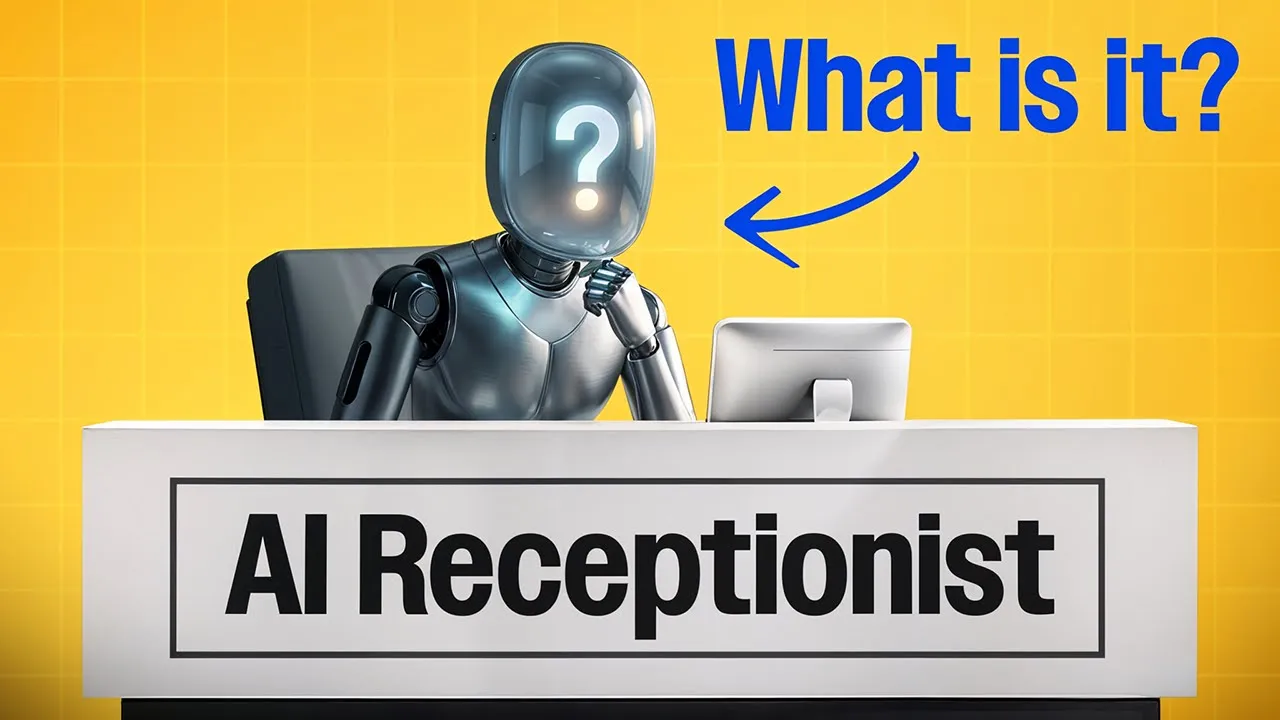
New to the AI Receptionist? Start Here!

Popular Use Cases
Below are some common use cases of AI phone assistants.
Front-desk automation
This is the first port of call when a customer or prospect phones into your business. Instead of relying on a human receptionist or virtual assistant to field your inbound calls, have your AI phone service answer them immediately. AI is always available, and customers don’t have to join a queue.
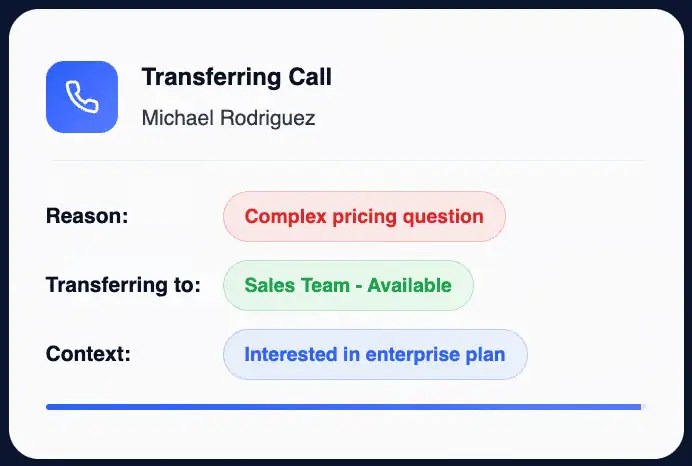
AI assistants greet callers, identify intent, and either resolve the issue or route the call to a human. This ensures no customer waits on hold or reaches voicemail.
Pro Tip: Use VIP numbers for select customers if you wish to bypass the automation and route them to a dedicated account manager.

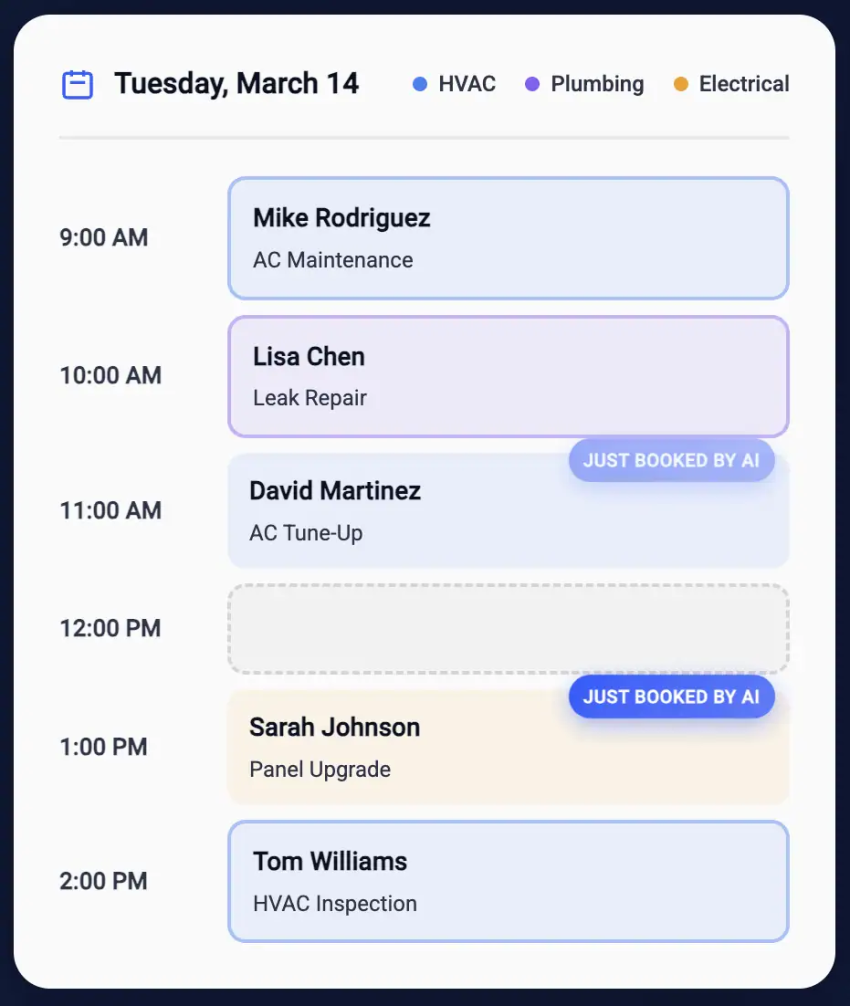
Appointment scheduling
When a customer buys something that requires installation, or they need to reschedule a maintenance appointment, there’s no need for live agents to search calendars for a mutual date.
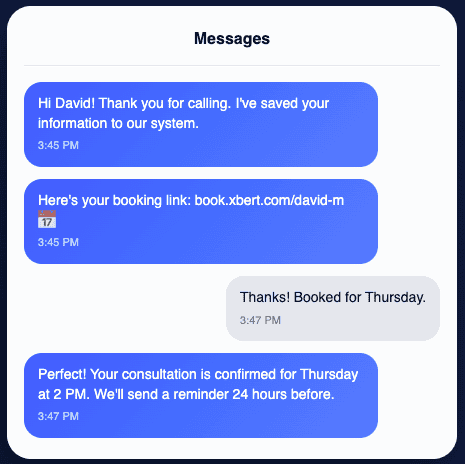
With real-time calendar integration, your AI assistant can schedule, confirm, and reschedule appointments automatically while sending reminders to reduce no-shows.

Lead qualification
Passing poorly qualified (or unqualified) leads to the sales team damaging trust and creates a division between marketing and sales. When you’ve got a scripted, pre-configured AI assistant asking qualifying questions, poor leads should no longer make it through to salespeople.
AI phone assistants gather lead details, ask qualifying questions, and update CRM records — accelerating follow-ups for sales teams.

After-hours coverage
Creating a follow-the-sun support function is expensive. The traditional approach is to hire staff in different time zones, fork out for overtime, or use a business process outsourcing firm. All these come with the cost of employing people.
An AI phone assistant doesn’t need sleep and is always available (or as much as you want it to be). By running 24/7, these after-hours answering services capture leads, answer questions, and route emergencies long after human staff have logged off.
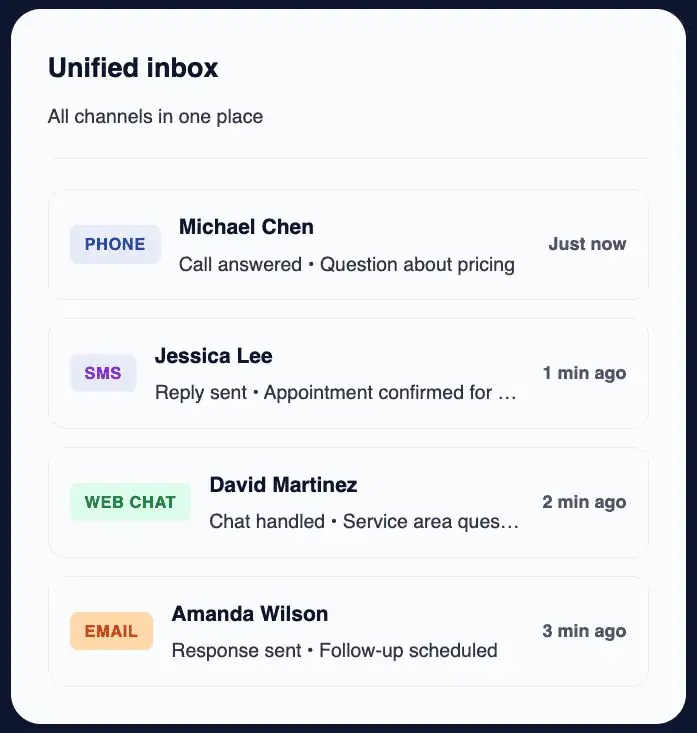
Multichannel customer support
AI phone assistants don’t just support phone calls. They can also integrate with channels like SMS and web chat, so every customer conversation flows seamlessly between channels.
Also, unlike humans, automated answering systems don’t need to focus on a single interaction to deliver the best quality. While people perform best one-to-one, modern systems can handle multiple conversations simultaneously without any loss in quality.

AI Phone Assistant Benefits
Now, let’s look at some of the key benefits AI phone assistants offer.
Always-on availability
One of the biggest appeals for an AI receptionist or assistant is that, unlike humans, they don’t need to take breaks or split into shifts.
Instead, they answer calls around the clock, including:
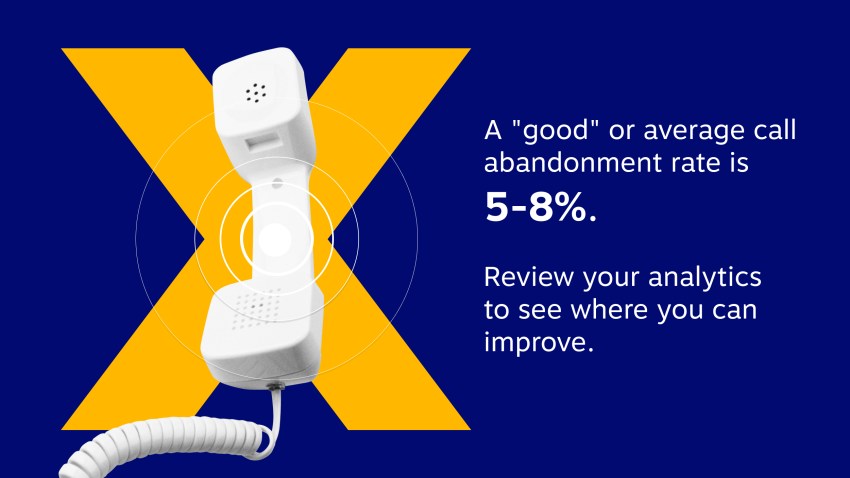
Every inquiry is handled immediately. Expect your call abandonment rate to plummet rapidly and permanently.

Lower operating costs
A single AI phone assistant can handle thousands of interactions per month at a fraction of the cost of a full-time receptionist or call center agent. Instead of employing dozens — or even hundreds — of agents to handle first-line and directional inquiries, you can free staff to focus on technical issues and empathetic conversations, and allow them to progress within the organization.
In comparison, an AI receptionist needs no breaks or vacation days, so there’s no dead time associated with your investment. Rather than paying tens of thousands of dollars for a human to simply answer the phone, opt for a more cost-efficient and streamlined solution.

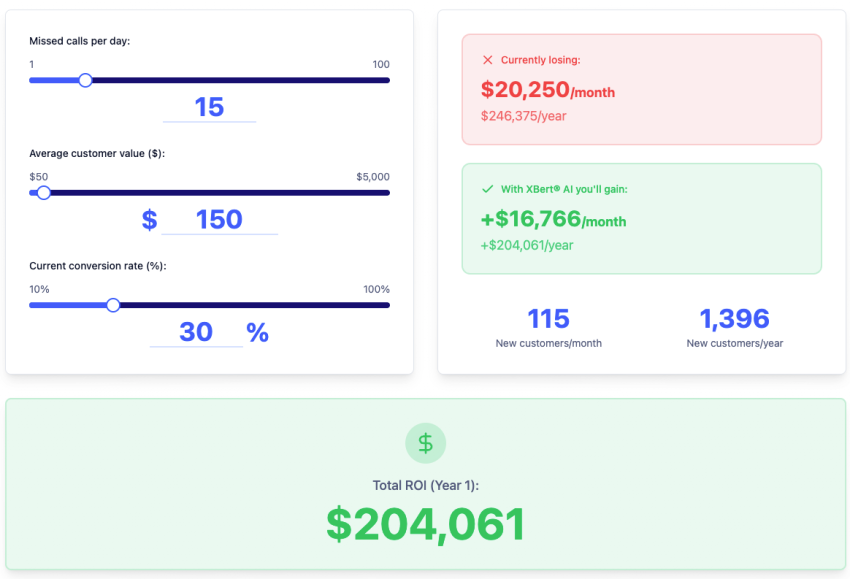
Try our free AI receptionist ROI calculator.
See how much your business could save with the XBert® AI Receptionist ROI Calculator. Just enter your call volume and staffing costs to find out how quickly an AI assistant can pay for itself and start freeing up your time.
Improved customer experience
What’s the biggest frustration customers face when they try to get hold of you?
That’s a trick question — there are quite a few. But at the top of the list are holding for too long and having to explain themselves over and over again as they progress through different call center agents.
AI phone assistants use natural language conversation, conversational AI, and instant responses to create smoother, more professional interactions. That means no hold times or transfers through multiple menus. The AI phone assistant resolves the query immediately, or it escalates the issue to a specialist, providing all the necessary context.

Data-driven insights
When you invest in any AI tool, you must measure and monitor the output and outcomes.
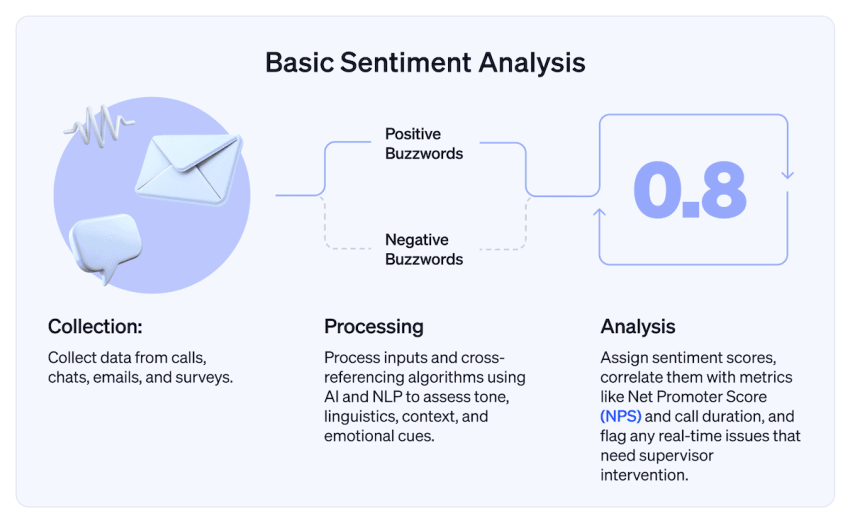
With every customer interaction, these AI assistants automatically record and transcribe calls, offering valuable analytics on customer intent, call volume, and booking rates. You get automated call summaries complete with a sentiment analysis score.
If something isn’t working quite how you want it to, you can tweak it. If a certain response type works better than others, use that more often.

Scalability
Here’s where AI truly shines. As your small business grows (or large business expands), AI telephony assistants handle increasing volumes — without the need for additional hiring or training — adapting easily across departments or locations.
Life without an AI assistant involves:
- Launching the hiring campaign
- Interviewing and shortlisting
- Onboarding selected candidates
- Providing initial training
- Pairing new hires with supervisors
- Overseeing new recruits as they learn on the job
- Budgeting for additional salaries
With an AI assistant, you start answering more calls. It’s as easy as that.
Top 3 AI Phone Assistant Solutions for Business
1. Nextiva XBert
Best for: Small and mid-sized businesses needing a full-service, 24/7 virtual receptionist.

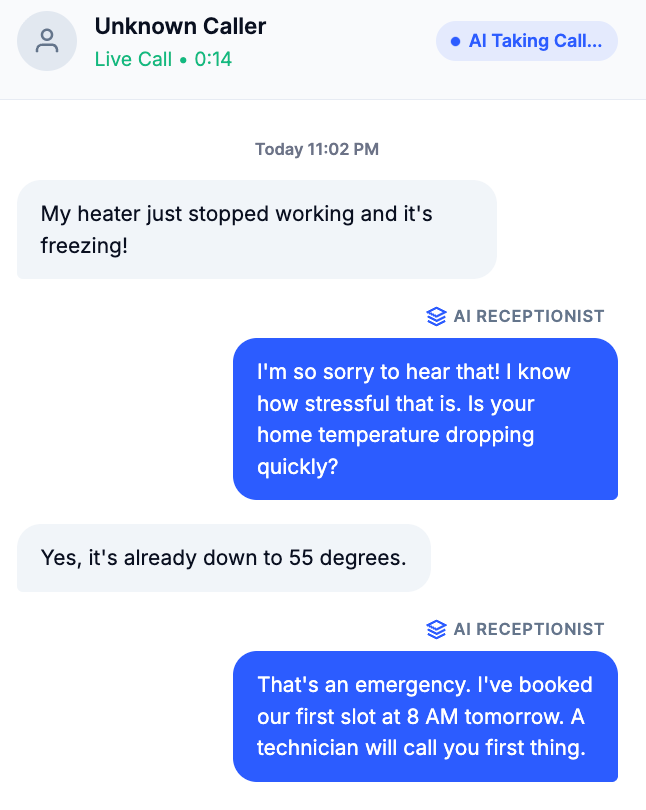
XBert AI is a conversational, multi-channel phone assistant built into Nextiva’s unified communications platform. It manages calls, texts, and web chats in real time with a lifelike voice and business-specific training.
XBert learns from your website, FAQ knowledge bases, and machine learning protocols to autonomously handle real customer questions. It can then schedule appointments, qualify leads, route calls, and integrate with your CRM for seamless follow-through. That covers the entire customer journey, if the scenario allows.
The best part? Businesses can go live in minutes, track transcripts and bookings, and have guaranteed uptime. Admins can check performance via a mobile app (with Android and iOS compatibility), accessible for all Nextiva business services.

Key Features:
- 24/7 call answering with customizable greetings
- Smart appointment scheduling and reminders
- Intelligent call routing and warm transfers
- CRM and calendar integration (Salesforce, HubSpot, Outlook, and Google)
- Real-time call transcripts and performance analytics
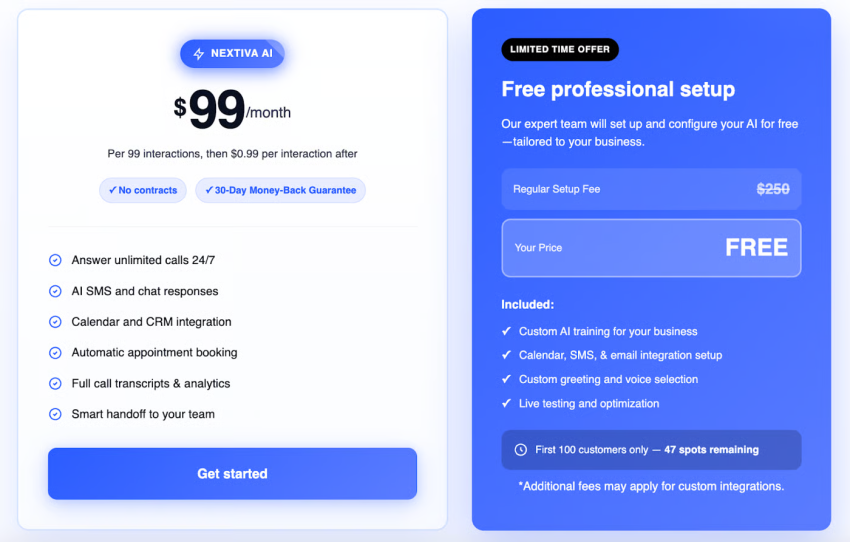
- Scalable pricing starting at $99/month
Why It Stands Out:
XBert provides all the front-desk capabilities of a live agent without the overhead, reducing missed calls and increasing booked appointments. It learns your business tone, adapts responses, and unifies every conversation across voice, SMS, and chat.

2. Bland AI
Best for: Technical teams building custom AI voice workflows.

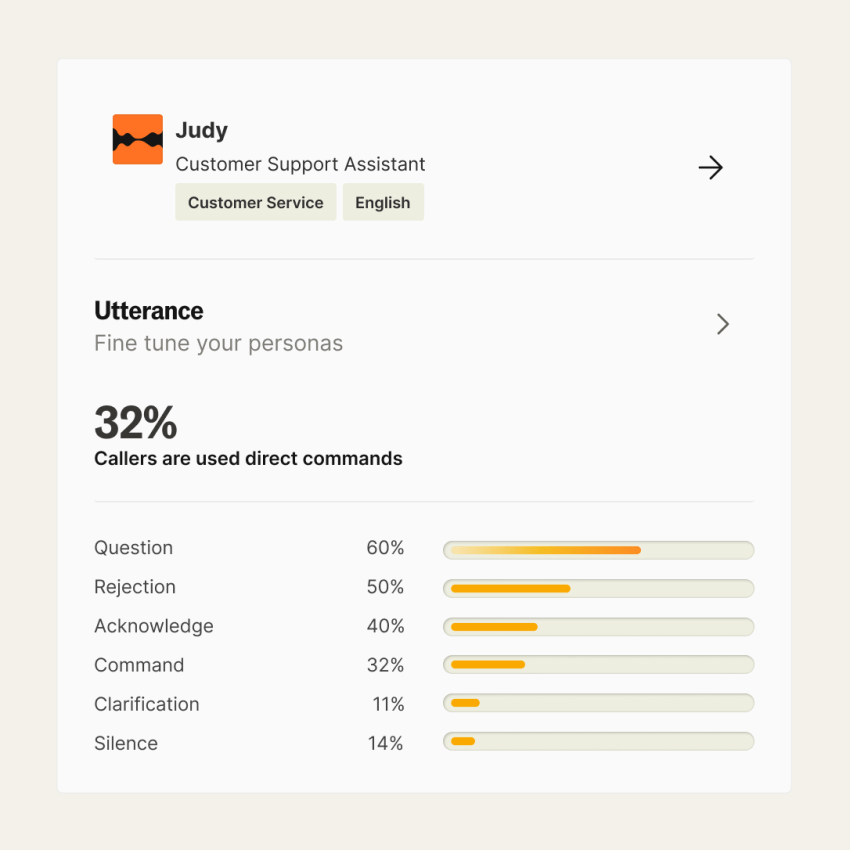
Bland AI is a developer-focused voice AI platform that allows teams to create custom phone agents using APIs and prompt logic. It’s flexible and powerful, but designed primarily for teams with engineering resources.
Key Features:
- Programmable AI voice agents via its API
- Custom prompts and conversation flows
- Webhook-based integrations
- Real-time transcription and speech synthesis
Why It Stands Out:
Bland AI offers a high degree of control over how voice agents behave. However, users should be aware of the total cost of ownership. While base prices start at roughly $0.09/min, additional costs such as failed-call fees, SMS charges, and warm-transfer billing can accrue as you scale.
3. Vapi
Best for: Advanced users and product teams experimenting with AI voice.

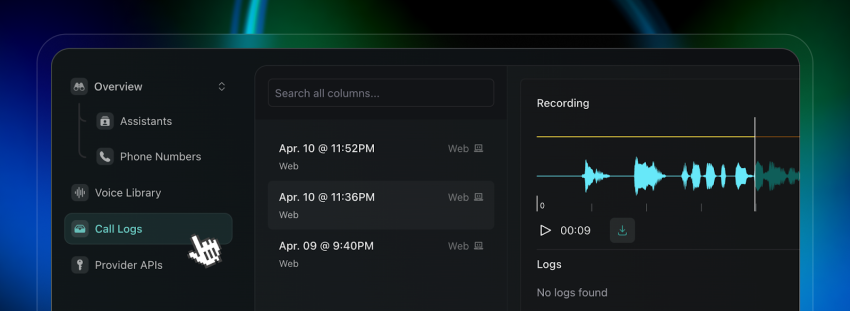
Vapi is an API-first voice AI platform designed for quickly building and testing conversational phone agents. It prioritizes speed and customization over packaged business features.
Key Features:
- Voice AI APIs for inbound and outbound calls
- Custom LLM and prompt configuration
- Real-time call control and transcription
- API-based integrations
Why It Stands Out:
Vapi works well as a building block for AI voice projects. However, because it’s a raw infrastructure tool, it lacks many of the out-of-the-box tools businesses expect, such as native scheduling, CRM syncing, and guided onboarding.
Nextiva: Get 24/7 Availability With an AI Phone Assistant
AI phone assistants have become a cornerstone of business communication. They combine automation, intelligence, and personalization to ensure no call goes unanswered and every opportunity is captured.
For organizations serious about customer experience, Nextiva XBert offers the most complete solution — handling calls, chats, and messages instantly while integrating with your CRM and calendar tools. It is an always-on, intelligent front-desk presence that scales seamlessly in line with your business.
Curious about the time savings and cost efficiencies? Try Nextiva XBert today.
Your AI receptionist that never misses a call.
XBert is your AI answering service that handles calls, texts, and chats 24/7. It greets customers, books appointments, and captures leads while your business grows.