


Ethereum’s last two major upgrades were focused squarely on Layer 2s. Glamsterdam, targeted to ship in H1 2026, is about improving Layer 1 — not just in terms of speed and efficiency but also the entire block production process. With execution increasingly migrating to L2s and Ethereum itself taking shape as the ecosystem’s underlying settlement and coordination layer, the question of who controls block production and under what rules is more important now than ever.
Ethereum’s latest upgrade, Glamsterdam, is targeted to go live in H1 2026, the third hard fork in a year. The two previous upgrades — Pectra and Fusaka, which deployed in May and December 2025 respectively — were primarily oriented toward Layer 2 scaling. Glamsterdam uniquely targets the base layer itself, addressing how blocks are built, who builds them and how the network orders and processes transactions.
At first glance, Glamsterdam could be mistaken for a straightforward performance upgrade, centred mainly on higher throughput, larger gas limits and lower fees. At a deeper level, however, it gets right to the heart of how Ethereum wants its base layer to function: not simply as a place for settling transactions, but as a predictable and coherent system whose most important market functions — today handled off-chain — are increasingly integrated within the protocol.
Developers call this “enshrinement,” and for institutions evaluating Ethereum as settlement infrastructure, it arguably represents the most significant set of changes since The Merge.
The Off-Chain Market Behind Ethereum’s Block Production
Ethereum’s block production today looks quite different from the protocol’s original design.
After The Merge in 2022, Ethereum moved to proof-of-stake, with validators assigned the right to propose blocks while the task of building them, selecting and ordering transactions, became a separate, specialised activity. Since then, proposer-builder separation (PBS) has come to account for the vast majority of Ethereum’s block production, with validators using third-party relay infrastructure to source blocks from specialised builders.
Builders compete to assemble the most profitable blocks, with relays acting as intermediaries that pass block contents to validators without advance disclosure. Over time, that builder market has become highly concentrated, with studies estimating the top three builders control more than 80% of all PBS blocks.
The result is a transaction ordering process that has itself become profitable, driven by maximal extractable value (MEV). A growing ecosystem of bots and specialised builders now compete for that value, often through arbitrage, liquidations and other ordering-based opportunities, turning block production into an off-chain market with its own economic logic and trade-offs.
Glamsterdam’s Two Core Changes
Glamsterdam’s two key proposals replace market functions that evolved informally outside Ethereum’s protocol with more explicit, rule-bound equivalents on-chain.
The first, Enshrined Proposer-Builder Separation (EIP-7732), moves the builder market into the protocol itself. Currently, validators trust relays not to manipulate or reveal block contents, a trust assumption sitting entirely outside protocol rules. Under ePBS, builders cryptographically seal their blocks and commit to a bid. Validators select the highest bid without seeing transaction contents, and the block is only revealed after the commitment is locked in. The result is a block-building market subject to the same consensus rules as the rest of the network, auditable and rule-bound rather than operating on the goodwill of intermediaries.
Block-Level Access Lists (EIP-7928) address execution throughput. Ethereum currently processes transactions sequentially because it cannot predict in advance which storage slots each will touch. BALs make that information explicit at the block level, allowing transactions that do not interfere with one another to be processed in parallel.
Former Ethereum Foundation co-executive director Tomasz Stańczak has indicated the resulting gas limit increase will be phased, reaching 100 million per block initially and 200 million once ePBS is fully operational, putting Ethereum on a path toward a throughput of 10,000 transactions per second (TPS) — many times faster than current levels.
Glamsterdam also bundles a package of gas repricing EIPs projected to lead to a roughly 78% reduction in fees.
What Glamsterdam Doesn’t Solve
ePBS makes MEV more transparent and moves it on-chain, a real improvement which doesn’t, however, remove the underlying incentive.
Under the current relay-based system, block construction depends heavily on off-chain coordination and trust. ePBS largely eliminates that but it does not remove the economic incentive to extract value from transaction ordering — it simply shifts where and how builders compete for it. A January 2026 academic paper modelling ePBS in the presence of MEV shows exactly how that shift plays out: while it reduces validator-side concentration, it “significantly amplifies profit and content centralisation” among builders, because access to private order flow still confers a structural bidding edge that compounds over time. The sophistication required to build blocks under ePBS with BALs may itself become a centralisation vector, favouring large-scale builders with low-latency infrastructure.
Another concern is the free option problem. A builder can withhold their block payload after committing to a bid if late-arriving MEV makes abandoning it more profitable. Academic modelling estimates this affects roughly 0.82% of blocks on average, rising to around 6% during volatile periods.
The changes also carry implementation risk. ePBS and BALs together represent a substantial increase in consensus-layer complexity, moving more block-building and execution logic into the protocol itself. That may make the system more legible, but it also creates a broader surface for bugs, edge cases and consensus failures, especially given that neither feature has yet been proven at mainnet scale.
Vitalik Buterin’s post-Glamsterdam roadmap, which includes FOCIL (confirmed as the headliner for the Hegota upgrade later in 2026) and encrypted mempools as subsequent steps, is the clearest sign that ePBS is a foundation, not an end in itself.
Why Institutions Are Watching
For institutions, Glamsterdam’s significance is less about the fee reduction and more about what auditable block production means in practice. By mid-2025, over 50% of high-value Ethereum transactions were being routed through private channels specifically to avoid MEV extraction, a workaround that suggests the current system does not always offer the level of predictability some participants require.

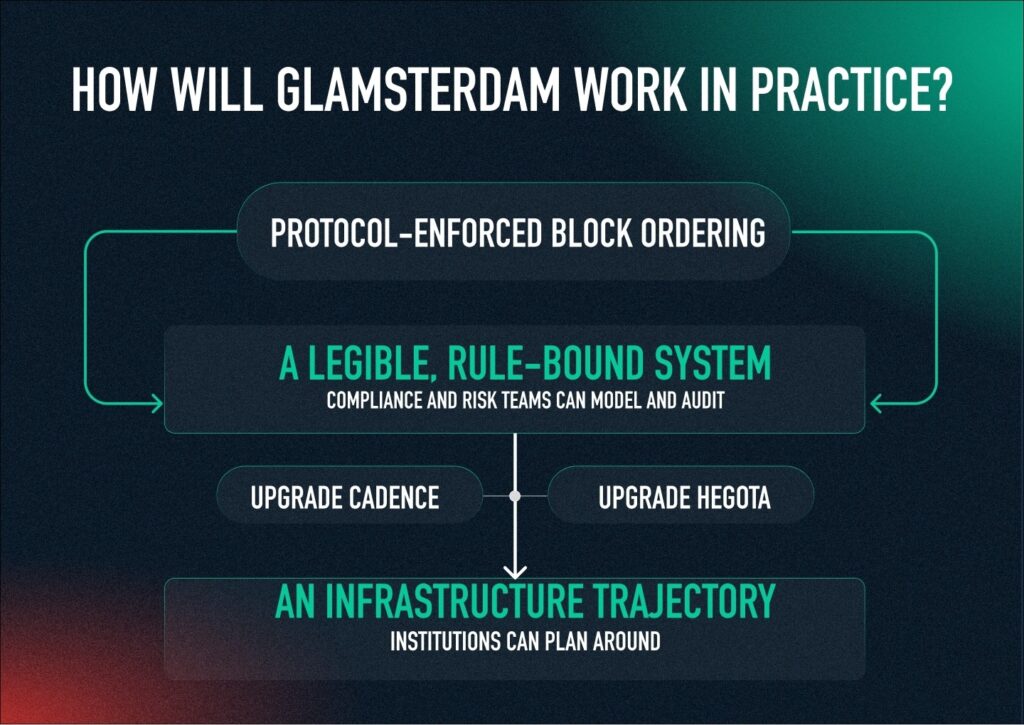
Protocol-enforced block ordering gives compliance and risk teams a legible, rule-bound system they can model and audit. Combined with Ethereum’s twice-annual upgrade cadence and Hegota already planned for late 2026, it signals an infrastructure trajectory institutions can plan around.
The wider significance is structural. If L2s in the future handle most execution while L1 serves as the settlement base, then the quality of L1 block production matters more, not less. The concern is not retail throughput on rollups but whether the coordination layer beneath them is predictable enough to anchor compliant, auditable activity at scale. Glamsterdam does not displace Layer 2 networks. Even at 200 million gas per block, L2s remain cheaper for cost-sensitive activity and offer sub-second finality that L1 cannot match. The more likely outcome is a cleaner division of labour, with L2s handling execution and L1 serving as the settlement anchor.
Glamsterdam will not resolve every remaining tension in Ethereum’s architecture. The competitive dynamics created by MEV-driven block production migrate more than they disappear, and the added complexity carries genuine implementation risk. But market functions that developed informally outside the protocol are being integrated, made legible, and placed under the same rules as everything else.
For an infrastructure layer that institutions are looking towards to anchor compliant financial activity, that is a significant step forward.