

Many businesses consider voice, video, and text as central channels for both internal and external use. While plenty of standalone tools exist, consolidating communications through a single platform is optimal.
A single communications platform means training your team to use only one tool. With only one dashboard to manage, you have a centralized place for all communications, avoiding the need to switch between multiple tools. Communication networks are the essential infrastructure that enables internet, voice, and video services, serving as the backbone of connectivity for individuals and businesses.
Here, we’ll discuss the key features and use cases of communications service providers (CSPs) and how to choose the right vendor for your business model — both now and as you scale in the future. CSPs play a vital role in enabling digital transformation and supporting the connectivity needs of modern organizations.
What Is a Communications Service Provider?
A communications service provider (CSP) is a company that delivers telecommunications, media, entertainment, applications, and other information-related services over a network. At its core, a CSP’s job is to ensure the reliable exchange and delivery of messages between people, services, and networks.
Types of communications service providers
CSPs span a wide range of service types, each built around a different delivery method or use case:
- Internet service providers (ISPs) deliver broadband and internet access to homes and businesses via cable, fiber, DSL, or wireless connections, often leveraging fiber optics technology to provide high-speed, reliable internet connections. Well-known examples include Comcast (Xfinity), Spectrum, and Cox.
- Mobile carriers provide cellular voice and data services through licensed wireless spectrum (wireless connectivity). AT&T, Verizon, and T-Mobile are among the largest in the U.S.
- Cable companies bundle internet, television, and sometimes phone service over coaxial or fiber infrastructure. Charter and Comcast are two of the biggest.
- Television and satellite broadcasting operators distribute video content to consumers via terrestrial broadcast, cable, or satellite signals. Dish Network and DirecTV are familiar examples.
- Content and application service providers deliver software, streaming media, and digital services over the internet. Netflix and Spotify operate at this layer, riding existing network infrastructure to reach users.
- Cloud communications providers offer voice, messaging, and collaboration tools hosted in the cloud, without requiring on-premises hardware. Nextiva, RingCentral, and 8×8 are examples built specifically for business use.
These categories aren’t always mutually exclusive. Many large CSPs also act as infrastructure providers, and operate across multiple categories, so a cable company may also be an ISP, and a mobile carrier may offer cloud communications tools for business customers.
CSPs for businesses
In the past, businesses relied heavily on landlines and emails for internal and external communication. However, given the digital transformation of the past two decades, that’s no longer the case. Communication service providers are enabling businesses by offering scalable and reliable connectivity solutions that support digital transformation and operational efficiency.
Today, there are two common types of CSPs built specifically for business needs: VoIP providers and Unified Communications (UC) providers
VoIP providers
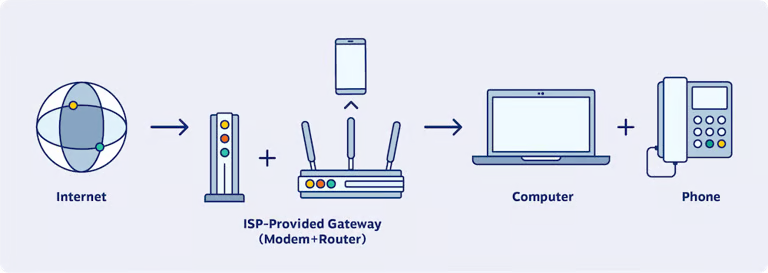
Instead of relying on traditional phone lines, VoIP phone systems allow businesses to make and receive phone calls over an internet connection. You can even access VoIP systems — sometimes called cloud phone systems — through mobile apps.
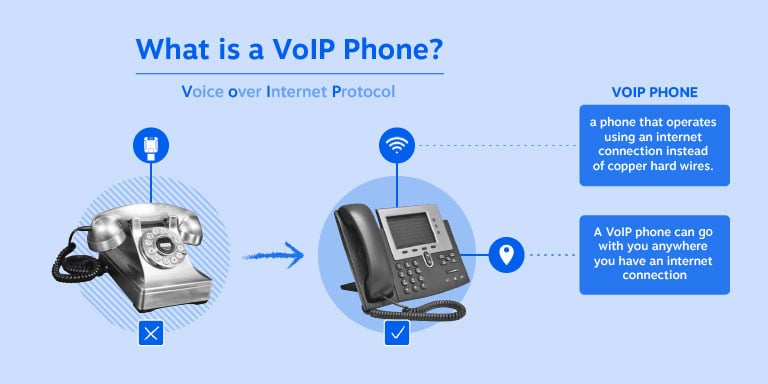
VoIP systems offer the following benefits:
- Cost-effectiveness: Often significantly cheaper than traditional phone lines, especially since they don’t require the purchase and installation of expensive hardware.
- Scalability: Easy to add or remove phone lines as your business grows or demand changes.
- Flexibility: Can be integrated with other communication tools, like video conferencing and instant messaging.
Unified Communications (UC) providers
UC providers go a step further and combine various communication channels (voice, video, chat, file sharing, etc.) into a single platform. Many UC providers offer Unified Communications as a Service (UCaaS), which eliminates the need to manage separate tools or on-premises infrastructure.
UCaaS solutions offer the following benefits:
- Improved collaboration: Streamlines communication and information sharing within teams.
- Increased productivity: Reduces time spent switching between different communication tools.
- Enhanced mobility: Allows employees to communicate and collaborate from anywhere with an internet connection, facilitating remote work opportunities.
The Business Model of Communications Service Providers
Your digital world runs on Communications Service Providers, and their business model is all about delivering the communication services that power everything you do online. Whether you’re running a business or just trying to stay connected, CSPs like internet service providers, mobile network operators, cable companies, and cloud communications providers are the backbone that makes seamless communication, internet access, and digital transformation possible across every sector you can think of.
Here’s how CSPs actually make money:
- Subscription-based models remain the bread and butter, with customers like you paying for internet access, television packages, or bundled communication services.
- Many CSPs also use pay-per-use models for specific data services or premium features, and some generate additional revenue through advertising or by partnering with application service providers and other businesses.
As cloud communications providers and OTT content providers expand their reach, CSPs are exploring exciting new business opportunities by offering virtual infrastructure and digital services to other companies.
It’s all about customer experience and data privacy. The best providers are constantly innovating to enhance service reliability, introduce new features that actually matter, and make sure your data stays secure. By leveraging digital platforms and integrating with business-critical applications, CSPs help companies like yours provide scalable and dependable communication tools that support real growth and collaboration, not just empty promises.
Core Services and Features of a Communications Service Provider
CSPs typically share a set of core services and features that make them well-suited for business communications.
Voice and calling services
Clear, reliable call quality is the foundation of any business communication platform. Most CSPs build their offering around voice services, so it’s worth looking for providers with strong service-level agreements (SLAs) that guarantee high uptime and call quality. Ideally, choose a provider that supports HD voice calls for the clearest possible experience.
Beyond basic calling, modern CSPs typically offer:
- VoIP calling: internet-based calls that replace traditional phone lines, reducing costs and hardware requirements
- Local and toll-free numbers: giving businesses a professional presence in any market
- International calling: for teams or customers spread across multiple countries
- Mobile calling apps: so employees can make and receive business calls from their personal devices without using a personal number
Call management features
Advanced call management allows businesses to automate and streamline key aspects of their communications. Popular features include:
- Call forwarding and routing: directs incoming calls to the right person or team automatically
- Voicemail-to-email transcription: converts voicemails into text and delivers them to an inbox for easy review
- Call recording: captures calls for training, compliance, or quality assurance purposes
- Call analytics: tracks call volume, wait times, and agent performance to inform staffing and process decisions
- Auto attendants: greets callers and routes them without needing a live receptionist

Together, these features improve efficiency and create a more professional experience for customers.
Integration capabilities
A major advantage of modern CSPs is their ability to connect with the other tools that businesses already use. Rather than operating in a silo, a well-integrated CSP plugs into your existing workflows, which reduces manual work and keeps data consistent across systems.
Common integrations include:
- CRM platforms (e.g., Salesforce, HubSpot): automatically log calls and surface customer data during conversations
- Help desk and ticketing tools (e.g., Zendesk, ServiceNow): link communications directly to support tickets
- Productivity suites (e.g., Microsoft 365, Google Workspace): sync calendars, contacts, and communication history
- APIs and webhooks: allow businesses with custom tech stacks to build their own integrations
Collaboration and messaging tools
Collaboration tools have become a core part of what CSPs offer, especially as remote and hybrid work has become the norm. Communication service providers deliver the necessary tools—essential infrastructure and technological solutions—that enable reliable connectivity, scalable services, and support for modern digital initiatives like cloud computing, 5G, and IoT.
Rather than juggling separate apps for different channels, many CSPs bring everything into one place.
Key collaboration features to look for include:
- Team messaging and chat: real-time messaging for individuals and groups, reducing reliance on email for internal communication
- Video conferencing: for face-to-face meetings regardless of location
- Screen sharing: allows teams to present, troubleshoot, or collaborate on documents during calls or meetings
- File sharing: lets teams send and store documents directly within the communication platform, keeping context in one place
When these tools are unified under a single CSP platform, teams spend less time context-switching and more time getting work done.
What to Look for in a CSP
When choosing a CSP, consider both your business’s immediate and long-term needs. Opt for a platform that aligns with your current budget and needs, but also plan for features and usage that you may need in the future as your business scales.
Keep in mind that businesses should evaluate how communication service providers adapt to the competitive landscape and implement strategies to stay ahead in a rapidly evolving industry.
Features & functionality
Features and functionality should be a core focus when choosing a CSP. Check that the CSP in question offers the specific features you need, for example, video conferencing, SMS messaging, and call analytics.
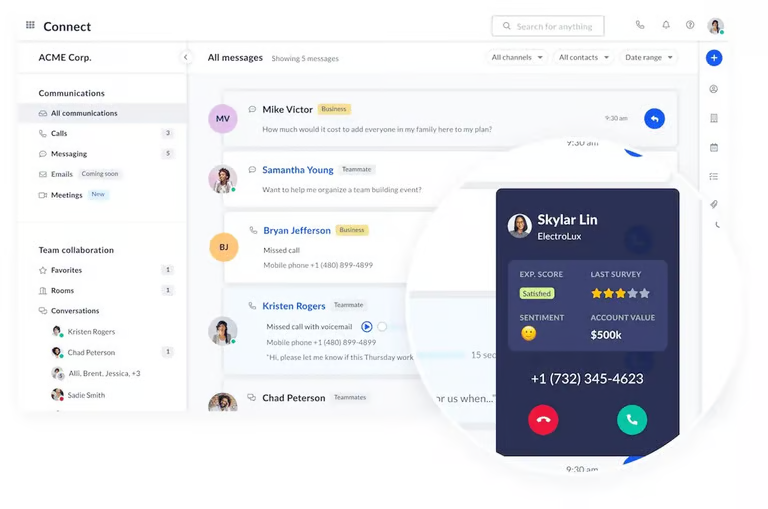
An increasing number of businesses are looking for a telecommunications service provider that offers some level of automation, including auto attendants for streamlined call routing or the option for automatic call recording.
CSPs are also increasingly leveraging innovative technologies, such as fiber optics and satellite services, to deliver improved and diverse communication solutions.
Reliability
The reliability of your CSP is critical. After all, you can’t help customers if calls are dropped, unclear, or unable to go through.
CSPs should have uptime guarantees built into their SLAs, offering peace of mind for the service’s reliability. They should also have disaster recovery plans, outlining what happens if there’s a service outage.
Security
Businesses should never overlook the importance of security features and processes. This is particularly true in regulated industries (for example, healthcare organizations that are legally required to follow HIPAA), but even small businesses should prioritize security.
Research the CSP’s data security measures. Calls, recorded calls, and additional data, for example, should be encrypted.
You can also look into the platform’s security accreditations. Some of the most important accreditations for CSPs include:
- HIPAA Compliance
- ISO/IEC 20071
- PCI Compliance
- SOC 2 Compliance
Cost & pricing
When considering a communications service provider’s pricing, look for the following:
- Transparent pricing structure: Avoid providers with hidden fees or complex pricing models. Check customer reviews on platforms like G2 or Capterra; some platforms mention hidden fees.
- Different scalable plans: Choose a provider that offers plans that accommodate your needs now and what you expect your needs to be in the long term. This includes plans with the right number of users, usage, and features.
- Long-term cost: Watch for platforms with higher upfront costs but lower monthly fees. Others may have a low “flat rate” price but require you to purchase individual features as add-ons.
Customer service
If your team is stuck when accessing call analytics, or if there’s an error with your recent invoice, you should feel confident that you’ll quickly get the support you need.
Always choose a CSP that offers the following:
- 24/7 technical support availability
- Responsive and knowledgeable support staff
- Training and onboarding resources for your employees
Some CSPs don’t create solid customer experiences and may lack support channels. Others may only provide prompt support to enterprise customers or subscribers of high-cost plans.
Integration with existing systems
When choosing a communications service provider, most businesses already have plenty of tools in their tech stack, so it’s important to choose a platform that will integrate with other key communication tools and digital services. Telecommunication companies should ideally be able to integrate with your CRM, email platform, and other critical business apps. Seamless integrations can save time and improve workflows.
Over the years, the telecom industry has evolved significantly due to technological advancements, deregulation, and increased competition. New technologies like 5G, AI, and edge computing are shaping global communication services and driving innovation for both telecom providers and CSPs.
The terms “communications service provider” and “telecom provider” are often used interchangeably, but they don’t mean exactly the same thing. Understanding the distinction can help businesses choose the right type of provider for their needs.
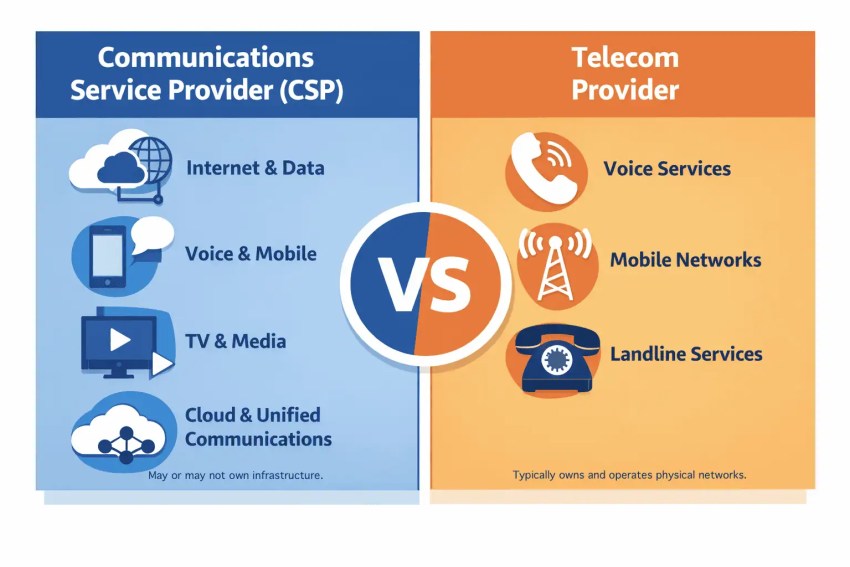
Telecom providers
These are companies that operate and maintain the physical network infrastructure used to transmit voice and data (think copper lines, fiber optic cables, cell towers, and satellites). Their core business is building and managing the pipes that carry communications traffic.
Traditional examples include AT&T, Verizon, and legacy carriers like BellSouth. Telecom providers are typically regulated by government agencies (like the FCC in the U.S.) and are primarily focused on connectivity.
Communications service providers
This is a broader term that includes telecom providers but extends well beyond them. CSPs can deliver services over networks they own, or over networks built and maintained by someone else.
A cloud communications company like Nextiva, for example, delivers voice and collaboration tools over the internet without owning any physical network infrastructure. It’s still a CSP, but it’s not a telecom provider.
The key differences come down to a few dimensions:
| Telecom Provider | Communications Service Provider | |
|---|---|---|
| Infrastructure | Owns and operates physical networks | May or may not own infrastructure |
| Services offered | Primarily connectivity (voice, data, broadband) | Connectivity plus applications, collaboration, and cloud services |
| Delivery model | On-premises or network-based | Often cloud-based |
| Target customer | Consumers and businesses | Primarily businesses |
| Examples | AT&T, Verizon, T-Mobile | Nextiva, RingCentral, 8×8 |
In practice, the line has blurred significantly. Many large telecom providers have expanded into cloud communications and software services, while CSPs have taken on capabilities that were once exclusive to telecoms.
For businesses evaluating providers, the more useful question isn’t which label applies, it’s what services are included, how they’re delivered, and whether they fit your specific communication needs.
Why Businesses Choose Nextiva as Their CSP
Almost every business needs the same core things from a CSP: reliable call quality, advanced call management, collaboration tools, and smooth integration with their existing tech stack. The right provider delivers all of this without forcing you to choose between features and affordability.
Nextiva does exactly that. With 99.999% uptime, transparent pricing starting at $15 per month, and 24/7 customer support, Nextiva gives businesses enterprise-grade reliability without the enterprise-grade complexity. Advanced features like call routing, custom greetings, voicemail-to-email transcription, and strong data security are available to all customers.
The results speak for themselves. The San Antonio Spurs turned to Nextiva to improve how they connect with fans:
“With Nextiva, our team doesn’t drop calls; there’s amazing voice quality, and it’s been an incredibly reliable way to connect with our fans and create a better customer experience.”
~ Chris Monroe, Associate VP of Membership
If you’re evaluating CSPs, don’t let price be the only deciding factor. The cost of lost customers and unreliable communications almost always outweighs the savings from a cheaper plan. Nextiva is built to make sure that’s never a trade-off you have to make.
The top customer conversations software.
Organize business communications for your customers, vendors, and teams with Nextiva.
FAQs
A communications service provider (CSP) is a company that delivers telecommunications, media, and information-related services over a network. CSPs handle the reliable exchange of messages between people, services, and networks, and can range from mobile carriers and internet providers to cloud communications platforms built for business use.
An internet service provider (ISP) is a type of CSP—but not all CSPs are ISPs. Internet Service Providers specifically provide internet connectivity (via cable, fiber, DSL, or wireless), while CSP is a broader category that includes any company delivering communications services over a network, such as mobile carriers, cloud phone providers, and unified communications platforms.
A telecommunications service provider is a company that owns and operates the physical network infrastructure used to transmit voice and data, such as fiber cables, cell towers, and copper lines. The term is often used interchangeably with CSP, but is more specifically associated with companies focused on connectivity rather than software or cloud-based services.
The top 3 U.S. telecom providers are Verizon, AT&T, and T-Mobile, although the ranking depends on whether you measure by subscribers, revenue, or market cap.
The answer depends on how you define it. If you mean the largest U.S. communication service providers overall, AT&T, Verizon, and Comcast are among the biggest by scale and revenue. If you mean business cloud communications platforms, Nextiva, RingCentral, and 8×8 are commonly cited options.