
Voice over Internet Protocol (VoIP) is a massive, fast-growing category that’s pulling traditional carriers and purpose-built platforms into the same buying conversation. For context, Precedence Research pegs the global VoIP market at $161.79 billion in 2025, with continued growth ahead over the next eight years.

This growth underscores the impact of VoIP services for businesses and highlights the number of companies investing in their communication platforms. When I talk to buyers who are already Verizon customers, the decision circles around what kind of system they’re actually buying. In this article, we’ll cover:
- An analysis of what Verizon One Talk is built to do (and isn’t)
- An assessment of where teams typically hit limits as they scale
- A side-by-side comparison table of both tools
- A guide to help decide which platform fits your business needs
Overview of Each Platform
Both Verizon One Talk and Nextiva have their individual strengths and weaknesses. Teams could benefit from either, but this entirely depends on the business stage and needs.
What is Verizon One Talk?
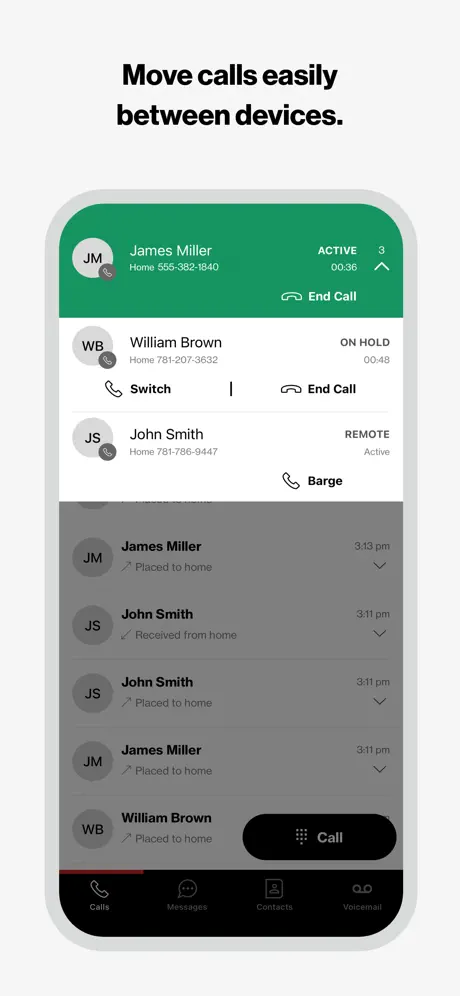
Verizon One Talk is a mobile-first communications solution that lets businesses give out one number across their desk and mobile devices. It’s only available to businesses in the United States. The app uses Verizon’s cellular network because it’s an add-on to Verizon Business wireless plans. While this means that it’s an obvious and convenient choice for Verizon account holders, it’s not actually a full communications suite.
Verizon One Talk has support for both Android and iOS devices, but it’s merely an extension of a Verizon carrier plan. Its setup makes business communications seamless across multiple channels at once, but it may lack advanced functionality and calling features that growing teams need to support scaling.
What is Nextiva?
Nextiva is a cloud-based business communications platform designed with businesses’ communication needs in mind.
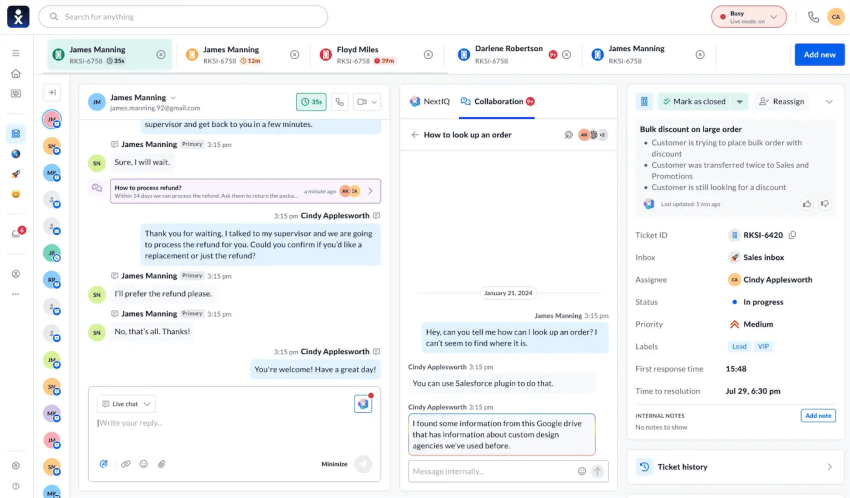
As a full communications suite (not an add-on), Nextiva has contact center capabilities and built-in artificial intelligence (AI) tools that allow teams to retrieve and analyze call center data to improve their communications stack. It also offers integrations with customer relationship management (CRM) and productivity apps. Designed for scalability, Nextiva supports growing teams with a purpose-built infrastructure.
Pricing Comparison
Pricing is where I see a lot of teams get tripped up, because starter prices rarely equal what you’ll actually pay once your business starts fully using the system. The cleanest way to compare Verizon One Talk and Nextiva is to look at published base pricing and then what happens when you need additional features like routing, queues, multi-person coverage, reporting, and admin controls.
Verizon One Talk pricing
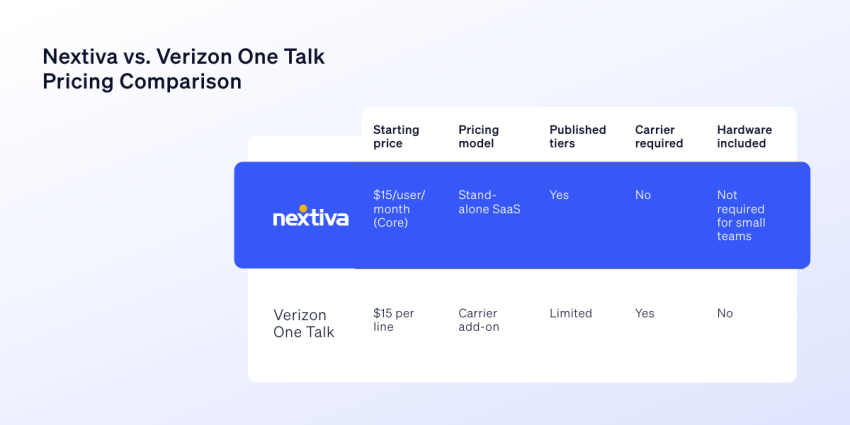
Since Verizon One Talk is positioned as an add-on to a Verizon Business plan, it’s priced per line. The basic plan is $15 per line, and teams can meet up with a Verizon representative to customize packages. This instantly signals that real-world costs can vary depending on the customized plan.
Here are a few cost dynamics I always flag for buyers:
- Carrier relationship requirements: Verizon frames One Talk as available to Verizon Business customers, and while the app can be used on non-Verizon devices, service purchase and eligibility require a Verizon Business account.
- Hardware costs: If your workflow needs desk phones or common area phones, that’s usually a separate hardware decision (and separate budget line), not something inherently included in a per-line starting price.
- Operational add-ons: You may need additional features that could show up in pricing, especially when you need to streamline your call handling (queues, auto attendants, call recording, ring groups, and voicemail upgrades).
- Volume discounts: Teams ordering 10 or more lines may qualify for reduced per-line pricing.
- Activation fees: Verizon One Talk may include one-time activation fees, which are separate from the per-line monthly cost.
Nextiva pricing
Nextiva approaches pricing more like a purpose-built business communications platform. It has published tiers, a clearer feature ladder, and an intuitive design.
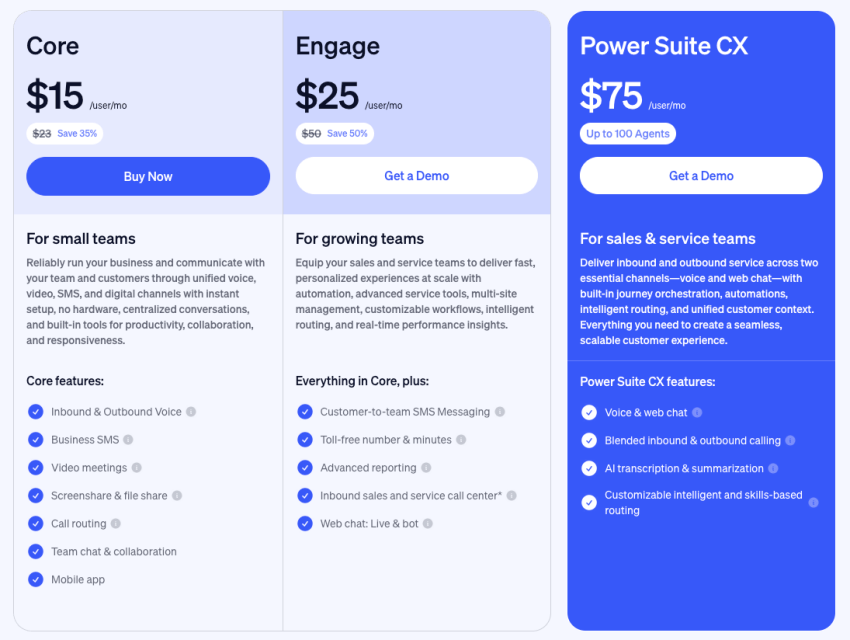
On its Internet Phone Service page, Nextiva publicly shows tiered pricing plans. For example, the Core plan is $15 per user per month, and the Engage plan is $25 per user per month. The Core plan offers unified voice, SMS text messages, and video meetings on one platform, emphasizing instant setup with no hardware required for small teams. There’s also no carrier lock-in, and teams have flexibility in how they deploy hardware.
With Nextiva, teams get:
- More predictable budgeting: When pricing tiers are transparent, it’s easier to estimate what happens as headcount grows or your call routing needs get more structured.
- Less piecemeal thinking: Nextiva’s platform brings together voice, messages, collaboration, call recording, and reporting.
Overall, while Verizon One may appear cheaper at the entry level, its add-ons and limitations for growing teams may have higher costs down the line. Total cost of ownership often favors Nextiva once features and scalability are considered.
Reliability and Performance
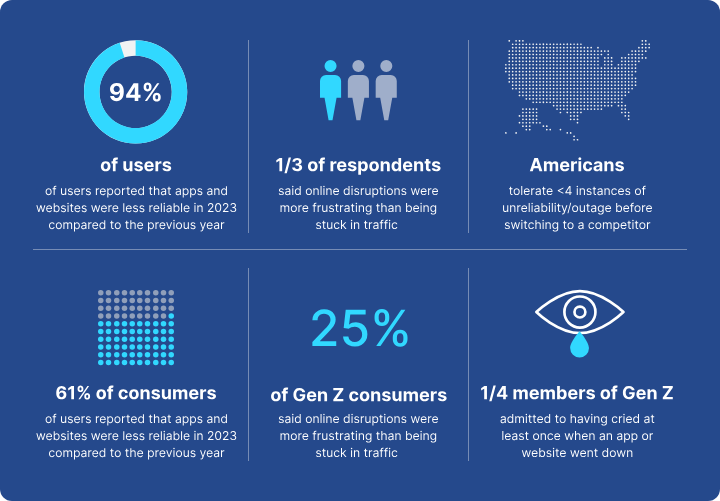
Above all, teams prioritize reliability when it comes to their tools. Businesses need a communications platform that experiences minimal downtime and can grow with them and accommodate their needs as they scale. Frustrations with the reliability of an app can cause users to abandon it completely.
Verizon One Talk
While Verizon One Talk is widely used (App Store has over 16,000 reviews for the tool), user reviews are both positive and negative. Some users say that it’s convenient and addresses the needs of starting teams, while others report reliability concerns like dropped calls, connectivity issues, occasional service interruptions, and voicemail transfers. Some reviews also suggest a flaky mobile experience and calls that require double-checking, as not all of them go through.
Nextiva
On the Nextiva side, the VoIP system is designed specifically for high-quality business voice calls across mobile and desktop devices, with operational tools, such as admin controls, routing logic, reporting visibility, and support team processes that users appreciate to help them manage reliability. Nextiva also strives for 99.999% uptime, providing the kind of concrete benchmark ops-minded buyers look for when they’re comparing long-term risk.
Customer Support Experience
When something breaks, what matters is how quickly you reach someone who can actually fix it. The difference between an add-on and an all-around platform is usually more emphasized here.
Verizon One Talk
Most of the complaints I see are structural. Big carrier support is optimized for breadth, not deep product-specific guidance. There’s no obvious path to a Verizon One Talk specialist. Users often describe long hold times and being routed through general Verizon channels, which can mean repeating the issue, bouncing between departments, or spending time with reps who don’t live in the Verizon One Talk product daily.
Nextiva
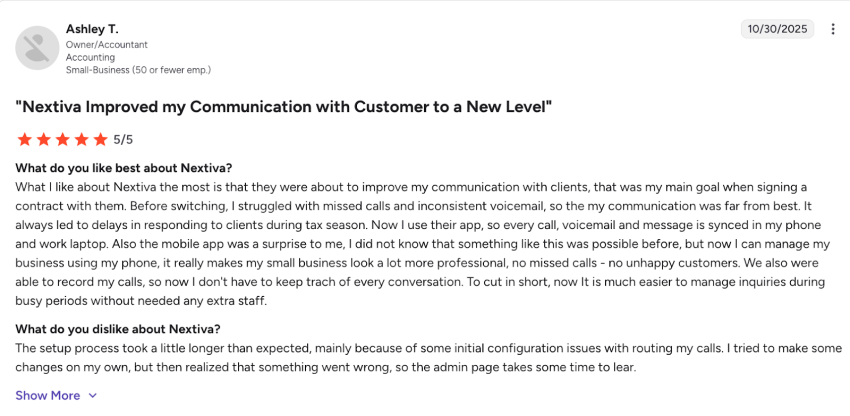
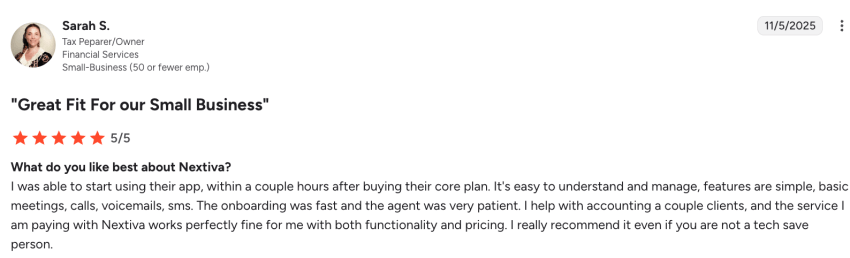
Nextiva provides dedicated support for businesses looking for unified communications for their customers (not consumer wireless at scale), which usually translates to faster resolution of issues and clearer product-specific troubleshooting from trained product specialists. Nextiva stands out for its onboarding resources and product-led support. It offers ongoing guidance that growth-stage businesses rely on for responsive assistance.
Features and Functionality
This is where most teams realize whether they bought a basic calling tool or a communications platform. It’s essential to consider ease of use, how far each one can stretch as your call flows, teams, and workflows get more complex.
Call management
Both tools cover the basics, but for anything beyond simple call-and-answer functions, more in-depth tools are needed. Those tools include:
- Auto attendants
- Call queues
- Call forwarding
- Call recording
- Call routing
- Ring groups
These are make-or-break features once you have multiple roles, such as sales team, ops, support, and you need after-hours logic, routing rules, or queue behavior you can tune. Verizon One Talk’s call queue configurations can scale up to a defined number of lines, which is helpful until you outgrow the model.
With carrier add-ons, advanced routing often becomes an unanticipated cost. Verizon’s One Talk is sold in a plan-and-add-on fashion, which can make the total cost climb as your call handling becomes more complex. Nextiva’s call management features are built into each plan, providing all-around call management tools for teams of all sizes.
Collaboration tools
- Verizon One Talk: Primarily voice and business texting or SMS basics, designed to extend a single number across devices, plus limited team collaboration tools
- Nextiva: More of a bundled collaboration posture, allowing for internal messaging, video meetings, video conferencing, shared workspaces, and broader team collaboration options designed to live alongside calling
AI and automation
For Verizon One Talk, AI isn’t positioned as a core, native differentiator because the system is mostly focused on extending a number across devices. Nextiva, on the other hand, positions AI as workflow support. It uses AI to power features like call summarization, transcription, automation, routing intelligence, and analytics that reduce manual follow-up and improve consistency.

Integrations
Verizon One Talk’s integrations tend to be lighter and less platform-native because the product is fundamentally carrier-led and focused on core calling. Integrations with CRMs and workflows exist, but they are more limited. On the other hand, Nextiva connects with CRMs and workflows (e.g., Salesforce and Microsoft Teams). It provides API access and supports automation that helps calls drive measurable outcomes.
Scalability and Growth
The best tool is one that can accommodate and support your business needs. Verizon One Talk and Nextiva each work well for specific kinds of teams.
Teams Verizon One Talk works best for
Smaller teams would benefit from the basic call functions that Verizon One Talk provides, especially if their communication system needs aren’t complex. Businesses that are already fully committed to Verizon will also benefit from Verizon’s One Talk because it’s a logical extension of Verizon Business. Additionally, teams in need of basic voice extension will find Verizon One Talk to be beneficial.
Teams Nextiva works best for
If your business is looking to scale, Nextiva is your best bet. Its different tiers are geared toward supporting businesses growing throughout various stages. It can also support multi-location companies and businesses located across the globe. Nextiva is best for teams that don’t just want a smartphone number on more devices, but want a communications system they can actually govern, measure, and evolve while delivering top-notch call quality.
A lot of teams start with simple calling, then suddenly need to look into better VoIP providers that cover contact center functionalities like call queues, better real-time analytics, IVR, coaching tools, and more structured workflows. Nextiva is built to grow in that way, and it’s meant for businesses that view their business phone service as part of their operational backbone.
Carrier add-ons are convenient when your needs are simple. Dedicated platforms, however, are what you choose when your business is scaling and you need a system that will grow with it.
When Verizon One Talk Makes Sense
Verizon One Talk can be a reasonable stopgap for teams that need business-quality calling that’s cleaner than what can be experienced with personal cell phones. It’s especially useful if you’re already living inside Verizon’s ecosystem. Verizon One Talk makes the most sense when:
- You are already a Verizon customer, and you want the simplest possible add-on without introducing a new vendor.
- You need minimal features (a single business number, basic ring behavior, and light admin).
- You want everything on one carrier bill, and you’re optimizing for procurement simplicity over platform depth.
- You have a team of fewer than 10 people, and call volume and routing complexity are still manageable without dedicated admin time.
Verizon One Talk is good enough for businesses in the early growth phase. However, it’s not designed to be the main operating system for customer conversations down the line.
When Nextiva Is the Better Choice
If your business phone system is core to your operations, I would suggest Nextiva. The tool is designed as a comprehensive communications platform from day one, offering in-depth features, support, and integrations that a strong VoIP solution needs while still being incredibly user-friendly.
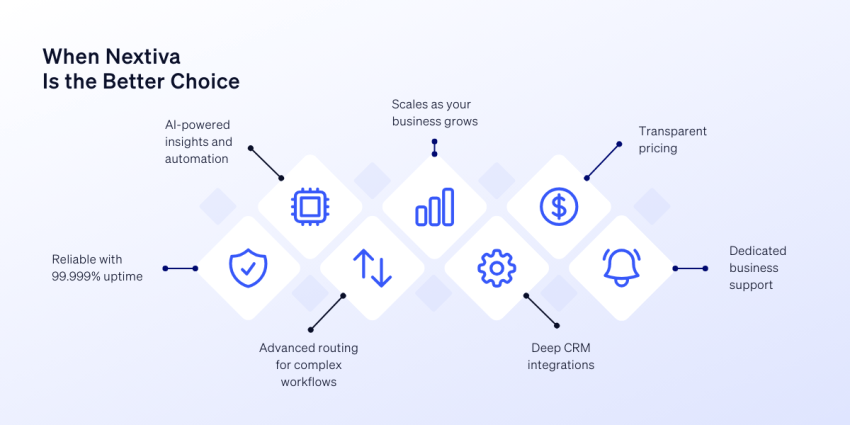
Nextiva is the stronger choice if:
- Reliability is critical, and unexpected call routing issues can create operational risk.
- You need AI tools to optimize workflows and help you get clearer insights into your communications.
- You need advanced routing that mirrors real operations.
- You plan to scale your business past a small business team, don’t want to outgrow your phone system, and want to keep your phone number the same.
- You need CRM integrations to automate follow-ups.
- You want transparent pricing to accurately predict how much business spending would be.
- You want dedicated business support.
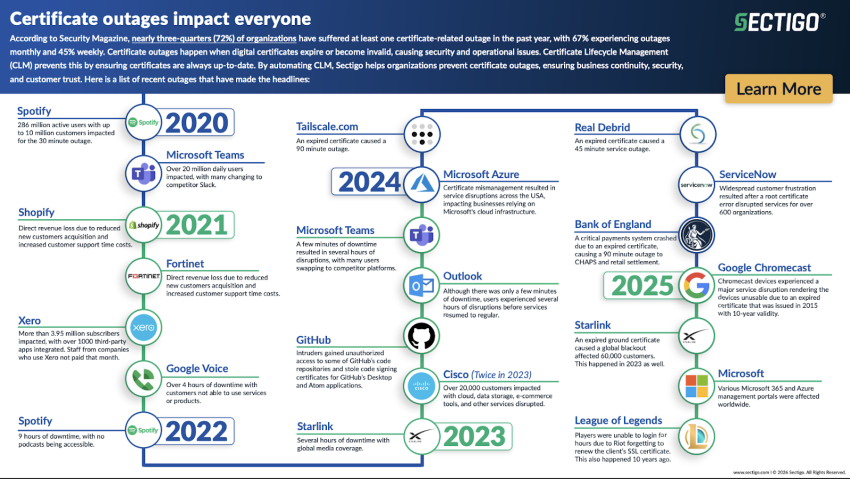
Reliability is a major part of any business’s selection criteria for tools. Shown below, Sectigo outlined major outages over the last five years, highlighting what happened when systems failed.
Quick Comparison Table
Here’s a quick table to help you compare Nextiva and Verizon One Talk across key factors.
| Category | Verizon One Talk | Nextiva |
|---|---|---|
| Starting price | Starts at $15 per line per month (pricing can vary by package and rep quote) | Starts at $15 per user per month, with tiered pricing published on Nextiva’s pricing page (easier to compare and forecast as you scale) |
| Hardware requirements | Runs primarily as a mobile-first add-on | Supports a wide range of hardware |
| Contract requirements | Add-on to Verizon Business | Terms depend on the plan chosen |
| Reliability | Includes user-reported issues (e.g., dropped calls, voicemail misroutes) | Positions as a business communications platform with high availability and strives for 99.999% uptime |
| Mobile app performance | Some report flakiness | Strong and specifically designed for business communications |
| Call routing | Basic routing | Built-in advanced routing, including flexible queues and logic |
| Auto attendant | Available typically as an add-on | Integrated into the platform |
| Call queues | Up to 40 One Talk lines | Robust call queue options |
| CRM integrations | Limited native integrations | Deep integrations (e.g., Salesforce, Microsoft Dynamics) |
| AI capabilities | Minimal AI in the core basic calling experience | AI-powered, uses AI for summaries, automation, analytics, and caller insights |
| Analytics | Limited to standard call activity records | Rich analytics with dashboards, performance insights |
| Support model | Big carrier support model | Dedicated business support |
| Scalability | Best for smaller teams | Built for growth |
| International availability | Primarily available for U.S. Verizon Business accounts | Available for more regions |
The Choice Is Clear for High-Growth Businesses: Nextiva
Verizon One Talk is a convenient, carrier-based extension for small teams already in the Verizon ecosystem. It can cover basic business calling needs without teams having to switch providers. However, Nextiva is a purpose-built communications platform for teams that treat a VoIP phone as critical infrastructure. This tool serves as the foundation for your workflows, accountability, and customer experience.
If you’re a growing business that needs reliability, scalability, integrations, and AI-driven tools, Nextiva delivers more long-term value and tends to come with fewer operational ceilings as complexity increases. With Nextiva, you can be more confident in your phone systems.
Switch to the #1 Rated Cloud Phone System to Run Your Business
Upgrade to the industry’s highest-rated hosted VoIP system. G2 ranked Nextiva as the #1 cloud-based VoIP provider. Get flexible, reliable cloud communications anywhere your team works.