
Bitcoin mining grid balancing is becoming an important consideration for utilities, grid operators and energy companies evaluating flexible industrial loads. Large mining facilities can reduce or increase electricity demand in response to power prices, congestion, curtailment requirements and grid conditions, creating a different operating profile from conventional baseload consumption.
Grid operators and utilities study Bitcoin mining loads for one practical reason: few large industrial loads can drop hundreds of megawatts on command and come back in minutes. Bitcoin mining supports grid balancing by acting as an interruptible load that consumes power when supply is plentiful and curtails during price spikes, grid stress, or emergencies, but its value to the grid depends on dispatch speed, metering, and contract terms that make that flexibility dependable. A mine that can shut down is one thing. A mine that is obligated, measured, and paid to shut down is a grid resource.
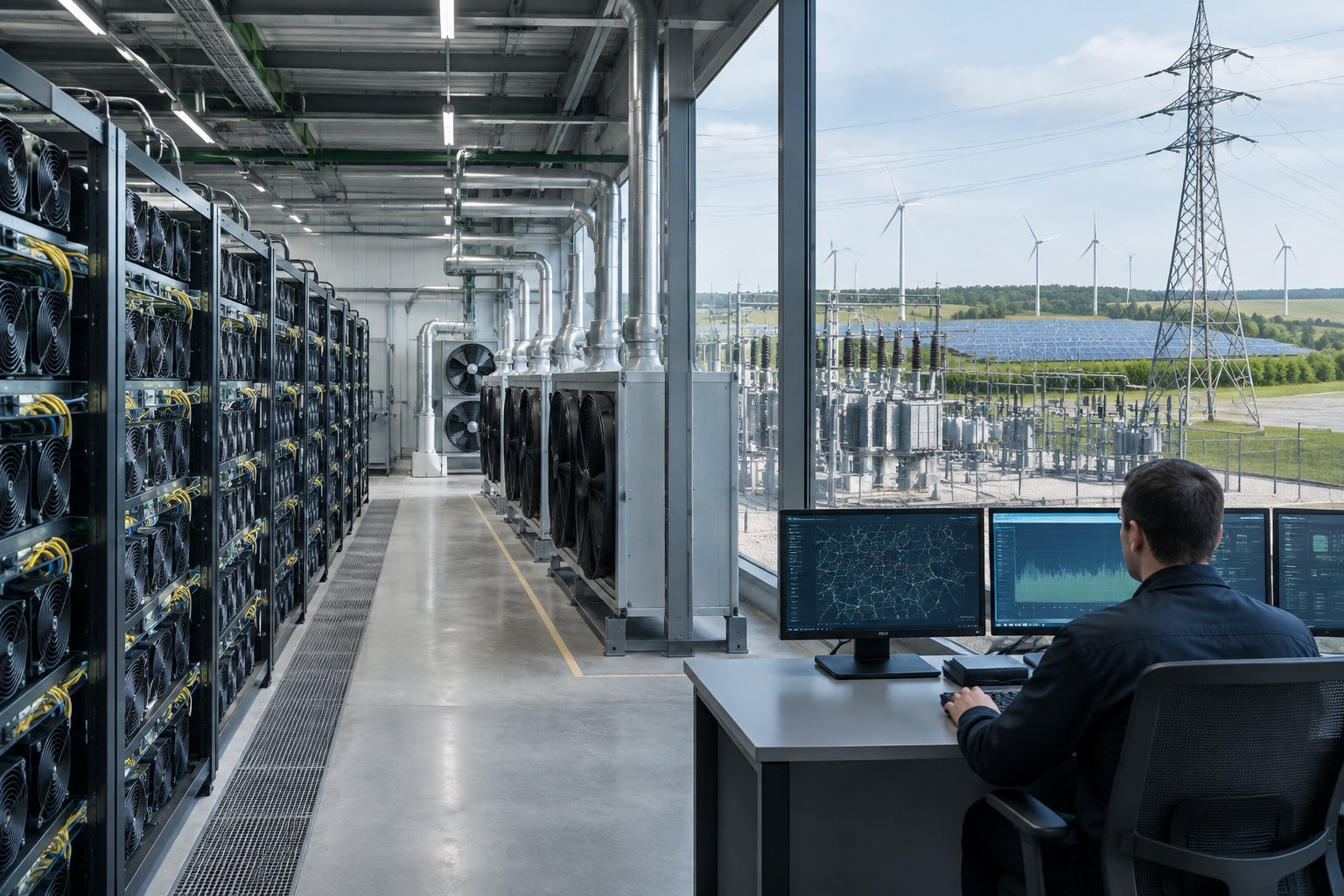
The stakes are rising. Texas regulators are sorting through a large-load queue far bigger than today’s peak demand, and AI data centers now compete with miners for the same substations. For energy companies, investors, and operators, the useful question is how much flexibility a specific facility will deliver, at what price, and under which market conditions. Readers who want to test their own power and fleet assumptions can explore the facility research and modeling tools at FarmBitcoin.
Key Takeaways
- Mining load is valuable to the grid only when its flexibility is fast, metered, and contracted.
- Hashprice and power prices decide when miners curtail, so available flexibility shifts over time.
- Curtailed renewable power is a real opportunity, but new mining demand can also raise costs and emissions.
How Can Bitcoin Mining Help Balance the Grid?
Bitcoin mining helps balance the grid by giving operators a large block of demand that can move up or down quickly with few lasting side effects. That makes it closer to a controllable resource than a fixed load, and the two features below explain why.
Why Mining Demand Is More Interruptible Than Conventional Data Center Demand
A mining computer works on short, independent tasks. If it stops, the lost output is the revenue from that window, with no half-finished product or broken customer service. Large mines are big enough to matter: in a 2023 legal memo, attorneys observed that modern bitcoin mines reach peak demands as high as 450 MW.
AI data centers and cloud facilities run work that customers expect to finish on time. Their operators sign service promises that make sudden shutdowns costly. Bitcoin miners carry no such promise to outside users, so they can trade output for flexible loads that respond to the grid’s needs. One demand response executive put it plainly in 2022, calling crypto mines “very different data center beasts” because they can shut down almost instantly.
What Changes When Miners Ramp Up or Shut Down
When a mine shuts down, electricity demand on the local system falls at once. That frees supply for homes, hospitals, and other users during tight hours, which supports grid stability. When the mine ramps up, it absorbs extra power that might otherwise be wasted or sold at negative prices.
Each move has side effects. A fast ramp-down helps during scarcity, while a sudden, uncoordinated ramp-up can strain local lines or shift prices. Grid operators therefore care about the shape of the response (how fast, how deep, and how smoothly the load returns) as much as its size.
When Does Curtailment Make Power Available?
Curtailment makes power available when a mine reduces load during hours when the grid is short on supply or the transmission system is congested. The value is highest during peak demand and emergencies, and it depends on the mine coming back online in an orderly way.
Demand Response During Peak Demand and Grid Stress
Demand response pays or credits large users for cutting load when the grid needs it. Mines fit well here because their response is quick and large. During Winter Storm Uri in February 2021, ERCOT stated that crypto miners reduced their demand to zero, which helped free power during the emergency.
Aggregators can also bundle mines into a virtual power plant, a group of flexible resources dispatched together. In July 2026, Enel North America and Braiins announced a program that compensates mining facilities for reducing load during peak events. Programs like this add to grid reliability and grid resilience only if enrolled sites respond every time they are called.
Load Shedding, Interruptible Power, and Controlled Restarts
Load shedding is the planned removal of demand to keep the system stable. Mines on interruptible power agree in advance to be shed first, often in return for a lower rate. The harder part is the restart. If thousands of machines power up at once, the surge can stress local equipment.
Firmware now allows staged recovery. One vendor’s documentation states that its firmware drops a miner to roughly 25 watts in under five seconds and restores full power in under ten, with wake-up delivered in steps. Those are vendor figures for individual machines; a full site also depends on cooling, switchgear, and how the operator schedules the return.
Which Grid Services Can Mining Facilities Provide?
Mining facilities can provide price-responsive load reduction, congestion relief, and, where they qualify, ancillary services such as reserves and frequency response. Each service carries its own rules, and the stricter services require proven telemetry and response times.
Price-Responsive Consumption and Congestion Management
The simplest service is following prices. When wholesale prices rise, a mine stops; when they fall, it runs. This helps grid management because load drops in the hours when expensive peaker plants would otherwise run.
Location adds another layer. In nodal markets, prices differ by point on the grid when transmission bottlenecks form. A mine sitting behind a congested line can absorb local surplus during low prices and back off when the constraint flips. That behavior eases congestion only if the mine’s location and response line up with the constraint the operator is trying to manage.
Requirements for Ancillary Services and Frequency Regulation
Ancillary services keep the grid’s frequency and reserves in balance second to second. In ERCOT, large flexible loads may participate as load resources in energy and ancillary service markets, and they are paid for being ready to reduce load. Qualifying usually involves:
- Real-time telemetry sent to the grid operator
- Under-frequency relays that trip load automatically
- Tested response times that meet the product’s deadline
- Penalties or loss of payment for poor performance
Frequency regulation, which moves load up and down continuously, is harder than one-time curtailment. Many mines offer reserves and leave fine-grained regulation to batteries and generators.
Where Can Mining Use Otherwise-Curtailed Renewable Power?
Mining can use otherwise-curtailed renewable power at sites where wind, solar, or hydroelectric output exceeds what local demand and transmission lines can carry. The opportunity is real but narrow, and it shrinks when new transmission capacity arrives.
Matching Mining Demand to Wind, Solar, and Hydroelectric Output
Energy curtailment happens when generators must cut output because the grid cannot absorb it. Wind power peaks at night in many regions, solar energy at midday, and hydroelectric power with seasonal water flows. A mine sited near those plants can buy surplus renewable energy during those hours.
Company examples show the possible effect on project finance. MARA reports that, in one of its wind projects, mining cut the time to return on investment from 8.1 years to 3.5 years. This is a company-reported figure, so readers should treat it as a case claim. Academic modeling is more measured: one long-run market study found that added Bitcoin demand raises the optimal amount of renewable capacity investment, with effects that depend on market design.
Why Transmission Constraints Limit the Opportunity
Stranded energy exists because transmission is scarce. A mine at the generator turns that scarcity into a buyer. Once new lines are built, that same power can reach cities, and the mine’s role changes from absorbing waste to competing with other users.
Interconnection rules also cap the opportunity. ERCOT requires studies before connecting loads of 75 MW or more, or 20 MW if co-located with generation, and a 500 MW project might receive approval for only part of its load until more transmission is built. Renewable energy integration through mining works best where curtailment is frequent and new lines are years away.
What Must a Facility Do to Deliver Reliable Flexibility?
A facility must prove its flexibility with controls, meters, and tested procedures that grid operators and counterparties can verify. Two areas decide whether claimed flexibility shows up during a real event: dispatch systems and on-site operations.
Controls, Metering, Dispatch Speed, and Verification
Grid operators pay for what they can measure. A mine needs revenue-grade metering at the point of interconnection, real-time data feeds, and an automated link between the operator’s signal and the fleet’s power targets. Manual responses are slower and harder to audit.
Verification also needs a baseline: what the mine would have used without the event. Because mines run near full load most of the time, baselines are easier to set than for many industrial users, but gaming risk still exists if a site lowers load before an expected event. Clear baseline rules protect both sides.
Uptime, Cooling, Fleet Management, and Restart Procedures
Frequent cycling affects hardware and cooling systems. Air-cooled sites must manage fans and airflow when machines idle, while immersion and hydro-cooled sites must manage fluid temperatures. Good facility operations include written restart sequences that bring load back in blocks, so the site does not trip its own breakers or the utility’s.
Fleet makeup changes the response too. Underclocking the whole fleet cuts power with a smaller loss of hashrate than turning off a share of machines; one vendor estimates a 10% drop cuts roughly 10% of power for less than 10% of hashrate. Some sites now use managed bitcoin mining services that handle dispatch and fleet tuning on the owner’s behalf. Owners should confirm who is accountable when a dispatch fails, since penalties land on the contract holder.
How Do Power Prices and Hashprice Affect Curtailment Decisions?
Miners curtail when the cost of running exceeds what the machines earn, plus any grid payment for stopping. Hashprice, the expected revenue per unit of hashrate, sets that line, so the same mine curtails at different power prices as Bitcoin markets move.
Comparing Mining Margin with Avoided Power Costs
Every machine has a breakeven power price. Efficient machines stay profitable at higher prices than older ones. A 2026 study of Texas found that mining load stays online at low prices and declines once prices pass an implied threshold, and that higher hashprice shifts this threshold to higher wholesale prices. The authors warn that treating mines as stable demand response may overstate their flexibility.
This matters for grid planning. When hashprice is high, miners hold out longer before curtailing. When it is low, older machines drop off early. FarmBitcoin’s hashrate economics research tracks how these inputs shift over time.
| Input | Pushes mine to keep running | Pushes mine to curtail |
|---|---|---|
| Hashprice | High | Low |
| Wholesale electricity prices | Low or negative | Spiking |
| Fleet efficiency | Newer, efficient machines | Older machines |
| Demand response payment | None or small | Large capacity or event payment |
| Transmission charges | Off-peak hours | Expected peak intervals (such as ERCOT 4CP) |
Accounting for Payments, Downtime, and Capital Costs
A full decision adds grid payments and avoided transmission charges to the savings side, and lost Bitcoin plus fixed costs to the cost side. Machines that sit idle still carry depreciation, financing, and staff costs. A 2022 industry estimate put grid-service revenue at 2% to 10% of a mine’s revenue, with curtailment running 100 to 500 hours a year.
The profitability calculator models installed hashrate, revenue, electricity costs, margins, and break-even power cost from user inputs. Its estimates exclude maintenance, labor, taxes, financing, and hosting unless separately modeled, so curtailment analysis should layer those costs on top.
Which Contracts Make Flexibility Bankable?
Flexibility becomes bankable when a contract defines when the mine must curtail, how fast, how performance is measured, and who pays if it fails. Lenders and grid planners rely on those terms, because technical ability alone gives them no assurance of future behavior.
Power Purchase Agreements and Interruptible Tariffs
Power purchase agreements can set fixed prices, index prices, or blends, and many include clauses that let the mine resell power or curtail at set price levels. Interruptible tariffs offer lower rates in exchange for the utility’s right to cut service. Both turn voluntary behavior into an obligation.
The structure shapes risk. A fixed-price deal shields the miner from spikes but may allow it to sell power back when prices jump. An index deal exposes the miner to spikes but rewards fast curtailment. A financing primer notes that lenders give the most favourable terms to energy infrastructure assets, such as substations and interconnections, since they hold value apart from Bitcoin.
Demand-Response Enrollment, Performance Rules, and Risk Allocation
Enrollment rules set the minimum size, notice time, event length, and number of events per year. Performance rules set how the operator checks the response and what penalties apply. Regulatory uncertainty remains a real risk: large-load rules in Texas and other markets keep changing, which can alter both payments and interconnection timelines.
Good contracts spell out:
- Who sends the dispatch signal and by what method
- The baseline method used for settlement
- Penalties for partial or late response
- Treatment of force majeure, such as equipment failure
- How rule changes by the grid operator flow through to the parties
Clear terms also support transmission infrastructure planning, since utilities can count firm interruptible load when sizing new lines.
What Can ERCOT and Other Power Markets Teach Operators?
ERCOT shows both the promise and the limits of mining flexibility, while PJM, SPP, and academic work show how market design shapes results. Operators should weigh observed behavior over modeled or company-reported benefits.
ERCOT Curtailment and the Limits of Company-Reported Results
The Electric Reliability Council of Texas has the most experience with large flexible loads. As of January 2023, 38,143 MW of such loads sat in its queue, compared with a peak load of 80,038 MW, and ERCOT formed a Large Flexible Load Task Force in 2022 to address frequency response and load-shedding issues. By June 2026, Texas regulators approved a batch-based queue as ERCOT faced 438,000 megawatts of requested demand, mostly from data centers.
Company figures deserve care. Riot Platforms reported more than $46 million in curtailment credits in the first three quarters of 2025, and advocacy groups have claimed mining saved Texans $18 billion. These numbers come from parties with a stake in the result. Operators should ask how baselines, counterfactual prices, and payments were calculated before relying on them.
Lessons from PJM, SPP, and Flexible-Load Research
PJM relies on capacity markets and aggregators. In 2022, Voltus announced plans to connect a 100 MW virtual power plant built with Mawson Infrastructure Group into PJM. SPP, with heavy wind in the Plains, offers lessons on congestion and nighttime surplus.
Research from Duke University’s Nicholas Institute in 2025 estimated that U.S. grids could add large new loads if those loads accept brief annual curtailment. MARA has cited this work as support for mining as a stabilizing tool for utilities. The study addresses flexible load in general, so its findings apply to mining only where mines accept similar curtailment terms.
When Might Mining Add Costs or Emissions Instead?
Mining adds costs or emissions when it creates new demand that fossil plants serve, or when it raises local prices and grid upgrade costs for other customers. The answer depends on what power the mine displaces and who pays for its connection.
New Demand Versus Genuinely Curtailed Energy
A mine running on power that would otherwise be curtailed adds little new emissions. A mine running around the clock on a grid where gas or coal sets the price adds greenhouse gas emissions. Critics noted in 2022 that some plants in New York and Pennsylvania were burning fossil fuels to power mining when they might otherwise have closed. The environmental impact of bitcoin is described in the literature as significant for energy use and emissions.
Claims of sustainable bitcoin mining or renewable-powered bitcoin mining hold up best with hourly matching and documented curtailment data.
Reliability, Ratepayer, and Emissions Trade-Offs
Large loads can raise wholesale prices in the hours they run. A high-resolution study of Texas modeled the joint impact of mining on carbon footprint, grid reliability, and electricity prices, finding that location and flexibility shape the outcome.
Curtailing a mine also does not automatically replace a peaker plant. A peaker plant adds supply on demand; a mine only reduces demand it created. Grid efficiency improves when that reduction is reliable enough for planners to count on it in place of new capacity.
Evaluating Mining as an Interruptible Grid Load
Bitcoin mining earns its place as a grid resource when its flexibility is fast, measured, and written into contracts. Firmware can drop load in seconds, and ERCOT has seen mines go to zero during emergencies. The amount of flexibility on offer still moves with hashprice and power prices, as recent Texas research shows.
For grid reliability, the strongest cases combine automated dispatch, revenue-grade metering, staged restarts, and contracts with clear penalties. Renewable value is highest at sites with frequent curtailment and slow transmission build-out. Operators and investors should test company-reported savings against baselines and counterfactuals, then check whether the mine’s power would otherwise be wasted or served by fossil plants. FarmBitcoin’s methodology describes how its benchmarks date and source these market inputs.
Bitcoin mining grid balancing depends on the ability of mining facilities to respond quickly to changing grid conditions. Through curtailment, demand response and interruptible-load agreements, operators can reduce consumption during periods of system stress and increase demand when excess generation is available. This flexibility can create value for both mining operators and energy markets when contractual terms, power pricing and operational controls are aligned.
The institutional case for bitcoin mining grid balancing should therefore be assessed through measurable grid value rather than broad sustainability claims. Energy operators should evaluate response speed, curtailment frequency, lost mining revenue, power-market incentives, interconnection constraints and the reliability of control systems. The objective is to determine whether flexible mining demand can improve grid economics without undermining facility profitability or system reliability.
Frequently Asked Questions
How quickly can Bitcoin miners reduce their electricity use?
Individual machines with modern firmware can drop to idle power in seconds. A full site usually needs minutes, because cooling and switchgear must follow the load. Grid programs judge response at the meter, so tested site-level times count more than machine specs.
Does Bitcoin mining actually improve grid reliability?
It improves reliability when mines curtail on time during scarcity and restart in an orderly way. ERCOT reported mines cutting load to zero during Winter Storm Uri. The benefit shrinks if high hashprice keeps miners running through price spikes or if their new demand tightens supply.
Who pays for Bitcoin mining demand response?
Grid operators, utilities, or retail power providers pay through ancillary service markets, capacity programs, or event payments. Those costs are spread across market participants and, in the end, ratepayers. Miners also gain by avoiding high prices and peak transmission charges.
Can Bitcoin mining reduce renewable energy curtailment?
Yes, at sites where wind, solar, or hydro output exceeds local demand and transmission capacity. The mine becomes a buyer for power that would otherwise be wasted. The effect fades once new transmission lines let that power reach other customers.
Does curtailing a mine replace a peaker plant?
Only in limited cases. A peaker adds supply, while a mine removes demand it created, so the grid gains only if planners can count on that reduction during peaks. Firm, contracted curtailment comes closest to substituting for new peaking capacity.