
Bitcoin mining energy markets determine much of the operating economics of industrial mining facilities. Power costs, contract structure, grid conditions, curtailment opportunities and access to flexible load programs can materially affect margins, uptime and capital returns. Institutional operators therefore evaluate bitcoin mining energy markets as both an energy-procurement problem and an infrastructure strategy.
Bitcoin mining farms make or lose money mainly on the price and timing of their electricity. The strongest power strategy pairs the lowest delivered power cost a site can secure with the freedom to curtail or resell power when grid prices rise above the fleet’s break-even level. A miner that pays a low fixed rate but cannot shut down during price spikes carries a different risk than a miner on spot pricing that can cut load in seconds. Operators, investors, and energy partners who compare both on the same terms can see which projects hold up when hashprice falls.
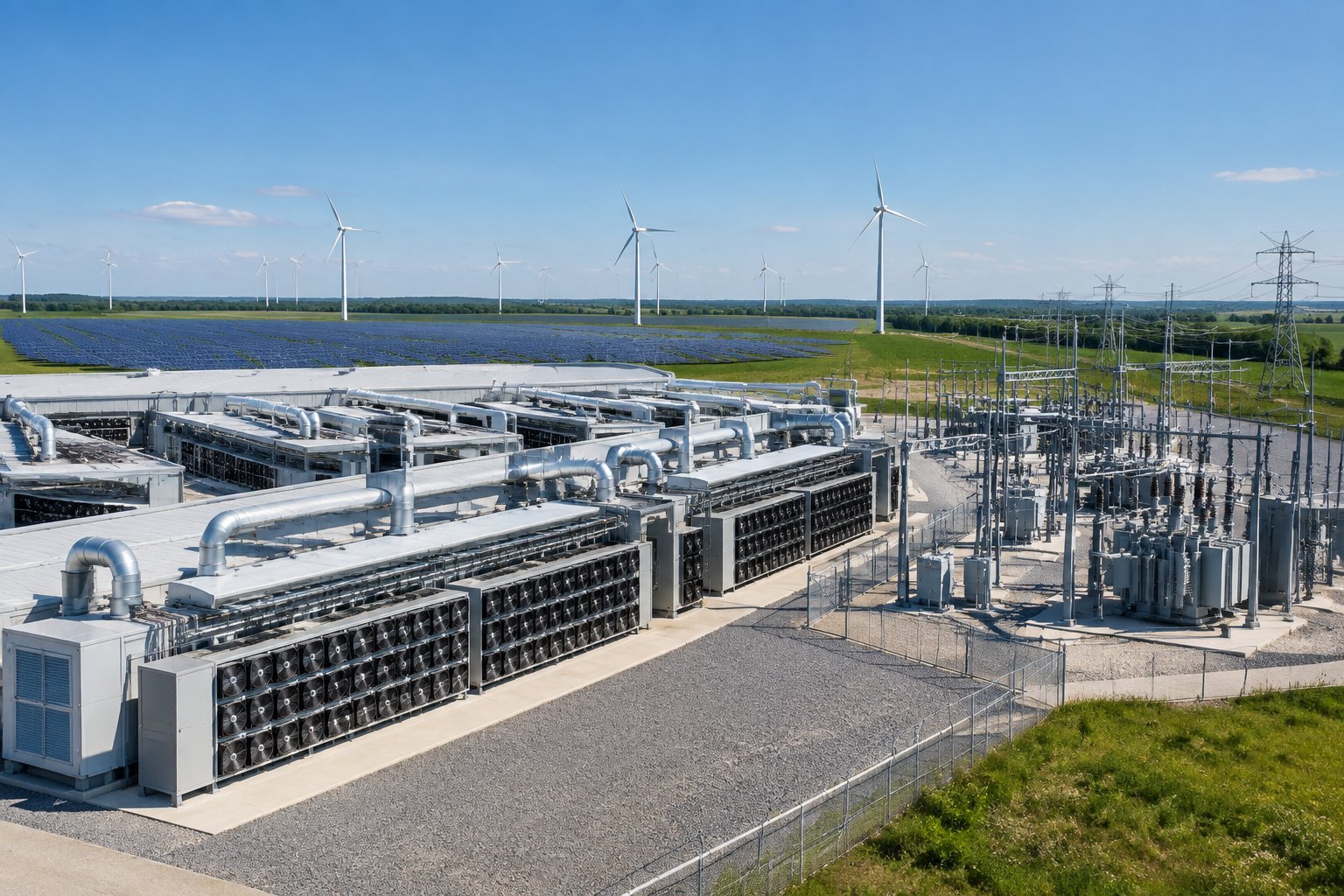
The stakes are large. The U.S. Energy Information Administration estimated in early 2024 that cryptocurrency mining probably used 0.6% to 2.3% of U.S. electricity. At that scale, contract terms, interconnection rules, and grid program design shape mining margins as much as machine choice does.
Readers who want to test their own site assumptions can start with the research and tools at FarmBitcoin, then come back to the frameworks below as a checklist.
Key Takeaways
- Delivered power cost and the ability to curtail decide most mining margins.
- Grid payments only add value when they beat the mining revenue a site gives up.
- Every power strategy should be tested across several hashprice and power price scenarios before capital is committed.
How Do Mining Farms Participate in Wholesale Power Markets?
Mining farms join wholesale power markets as large loads that can raise or lower their use quickly in response to price. That flexibility comes from how Bitcoin works, and it creates a simple rule: mine when power is worth less than the hashrate it buys, and stop or resell when it is worth more.
Why Proof of Work Creates a Flexible Electricity Load
Proof of work rewards computing effort, and that effort has no memory. A machine that shuts off for an hour loses that hour’s revenue, but it does not ruin a batch, damage a product, or break a process. Steel mills and chemical plants cannot say the same.
This makes bitcoin miners unusual buyers in energy markets. Their load can drop in minutes and return just as fast. Grid operators value that trait because they must balance supply and demand every second. Price-sensitive miners also behave like a buyer of last resort in places where power is cheap and hard to move.
When Is Mining More Valuable Than Selling Power?
Mining is the better use of a megawatt-hour when the revenue from hashing exceeds both the power price and any resale value. A miner on spot pricing faces one choice each interval: run or stop. A miner holding a fixed-price contract has a second option, which is to sell the unused power back at the market price.
| Contract position | When prices are low | When prices spike |
|---|---|---|
| Spot (indexed) | Mines at low cost | Shuts down, earns nothing |
| Fixed-price with resale rights | Mines at contract cost | Resells power, captures the spread |
| Fixed-price without resale | Mines at contract cost | Must run or waste paid-for power |
The resale right is what turns a price spike from a threat into income. Without it, a fixed contract only locks in cost.
How Do Miners Procure Electricity?
Miners buy power through fixed-price contracts, indexed or spot pricing, power purchase agreements, direct links to generators, or a mix of these. Each route trades certainty for flexibility in a different way, and the fine print on curtailment often matters more than the headline rate.
Fixed-Price Contracts vs. Indexed Power
Indexed power follows real-time or day-ahead market prices. It gives the lowest cost in calm, oversupplied hours and full exposure during scarcity. A spot miner is short power: it benefits when prices fall and suffers when they rise and stay high.
Fixed-price power sets a known $/MWh rate for a set term. It supports budgeting and lending, and it makes the miner long power, since high market prices raise the value of the contract. Many operators split the difference. A 20 MW site, for example, might fix 10 MW and leave 10 MW on spot so that it can follow cheap hours while keeping a hedge.
Power Purchase Agreements and Their Curtailment Terms
A power purchase agreement (PPA) commits the buyer to a fixed volume at a fixed price, used or not. The value of a PPA for a miner depends on a few clauses:
- Whether the buyer may resell unused power, and at which pricing node
- Take-or-pay terms and minimum consumption levels
- Who keeps the spread when the miner curtails
- Penalties for running below the contracted volume
- Pass-through charges for transmission, capacity, and ancillary costs
Two PPAs with the same headline price can produce very different margins once these terms are priced in.
Grid-Tied, Behind-the-Meter, and Hybrid Supply
Grid-tied sites buy through a utility or market and can respond to price signals. Behind-the-meter sites sit at a generator and take power directly. The EIA points to sites near hydroelectric dams, beside natural gas wells, and one Pennsylvania mine fed by an adjacent nuclear plant.
Hybrid setups blend the two. A miner might draw base load from a dedicated generator and fill gaps with grid power when prices are low. This raises uptime compared with a pure off-grid site while keeping part of the load price-responsive.
How Does Power Cost Determine Mining Margins?
Power is the largest operating cost for most mining farms, so the electricity price sets the floor under every margin. Mining profitability comes down to whether revenue per unit of energy stays above the price paid for that energy, after uptime losses.
From Electricity Price to Break-Even Power Cost
The break-even power price is the highest rate at which a machine still covers its electricity. A common formula is:
Break-even $/kWh = hashprice ($/PH/day) ÷ (24 × efficiency in J/TH)
At a hashprice of $40 per PH/s per day, a 17.5 J/TH machine breaks even near $95/MWh. A 30 J/TH machine breaks even near $56/MWh. The older fleet runs out of room first every time hashprice drops.
This is a gross line. Hosting fees, labor, pool fees, and maintenance push the real all-in break-even lower. The FarmBitcoin profitability calculator reports a break-even power cost from facility capacity, fleet efficiency, uptime, pool fees, BTC price, and hashprice, but its estimates exclude maintenance, labor, taxes, financing, and hosting unless the user models them separately.
How Hashprice, Fleet Efficiency, and Uptime Change the Calculation
Hashprice moves with bitcoin price, transaction fees, and network difficulty, so the break-even line shifts daily. Efficiency improvements raise the line. Underclocking can also help, since machines run at better J/TH at lower power, which is why partial curtailment often beats a full shutdown.
The cost per coin shows how tight margins can get. One published model estimated about 969.04 MWh of energy and roughly $64,635 in electricity per BTC at a $67,200 bitcoin price. That is a modeled estimate under its own power price and fleet assumptions, not a measured result for any single site.
Modeling Revenue Lost During Power-Saving Shutdowns
Every curtailed hour removes revenue. A sound model counts three things for each shutdown:
- Power cost avoided, or resale income earned
- Mining revenue forgone at the hashprice of that hour
- Fixed costs that continue during downtime, such as staff and debt service
Uptime assumptions belong in the base case. A site that plans for 98% uptime but curtails 8% of hours will miss its payback target even if each shutdown was the right call.
When Should a Mining Farm Curtail?
A mining farm should curtail when the power price, or the resale value of contracted power, rises above its all-in break-even. Curtailment decisions only work when they are made in real time and account for the cost of turning back on.
Responding to Wholesale Price Spikes
On spot power, each interval is a decision point. In ERCOT, prices settle in five-minute steps, and spikes can be short and sharp. Spot miners are indifferent to how high a price goes once they are offline. Whether power hits $80 or $800/MWh, the loss is the same mining revenue forgone.
A tiered response often works best. Fleets run at full power below the all-in line, step down to lower power profiles in the band between the all-in and gross lines, and curtail fully above the gross line. Software that reads live price feeds and hashprice can carry out these steps in seconds.
Accounting for Restart Costs and Operating Constraints
Restarts are cheap for ASICs but not free. Frequent cycling adds thermal stress, and some cooling systems, especially immersion setups, need time to stabilize. Contract terms add limits too. A minimum-load clause, an ancillary service award, or a take-or-pay PPA can force a site to keep running when the market says stop.
Operators should log every curtailment event with the price, duration, and revenue lost. That record shows whether the trigger level is set correctly.
How Can Miners Earn Value from Grid Flexibility?
Miners earn grid value by getting paid to reduce load on request, through demand response and ancillary service programs. These payments improve economics only when they exceed the mining revenue given up and the risks taken on.
Demand Response and Ancillary Service Programs
Demand response pays large users to cut use during peak demand or grid stress. Ancillary services pay for being ready to cut load within minutes or seconds. Texas has used both. The EIA reports that ERCOT’s Large Flexible Load program enlisted up to 1,530 MW of large industrial users, with crypto miners as major participants.
Ancillary awards come with duties. A site that accepts one must stay online at or above a set load during the award hour, even when power prices make mining a loss.
Measuring Payments Against Forgone Mining Revenue
The test is simple to state. Grid payments plus avoided power cost must exceed forgone mining revenue plus any penalties. The structure underneath decides the result:
| Setup | AS payment risk |
|---|---|
| Spot power + floating pool payouts | High; may mine at a loss to stay compliant |
| Fixed power + floating payouts | Moderate; cost is known, revenue moves |
| Fixed power + fixed payouts | Low; both sides locked in |
A miner on spot power that must stay online through a price spike can lose more on electricity than it earns from the award.
What Documented Operator Examples Can Show
Riot Platforms runs a large site at a former aluminum smelter in Rockdale, Texas. EIA notes that operators of two large mining facilities at that site estimate each can need up to 500 MW. Public filings from Riot report power and demand response credits in some periods, and those figures are useful because they are disclosed and audited.
Readers should treat any reported credit as a result for a specific year, price environment, and contract. A strong year of credits during a hot summer does not set a baseline for the next one.
Where Does Stranded or Surplus Power Fit?
Stranded or surplus power fits mining where generation exists but cannot reach paying buyers because of weak transmission, low local demand, or a mismatch in timing. Surplus energy offers low delivered cost, but uptime then depends on the resource.
Colocating with Constrained Generation
Colocation puts a mine at a wind farm, solar plant, hydro dam, or gas well that faces curtailment. The generator gains a buyer for power that might otherwise earn nothing or a negative price. The value is location-specific. A site needs recurring curtailment, very low local prices, or a real transmission bottleneck to make the case. Without those, a miner is one more competing load.
Research on planned renewable installations found mining profitable in 80 of 83 examined cases, a modeled result that depends on the inputs used in that 2024 study.
Off-Grid Mining and the Cost of Variable Uptime
Off-grid sites run on availability, not price. If a wind farm makes 10 MW, the miner can use only 10 MW, even with a 20 MW allocation. Unused energy is lost because it cannot be sold. These sites often have lower variable costs but higher upfront capital, since roads, power gear, and communications may need to be built from scratch.
The modeling shift is clear. Off-grid economics focus on margin while running, and payback must assume lower uptime than a grid-tied site.
How Does the Energy Mix Affect Project Decisions?
The energy mix affects project financing, permitting, public acceptance, and contract structure. Renewable energy and fossil fuels each bring distinct costs and risks that belong in the investment case.
Renewable Integration and the Limits of a Buyer-of-Last-Resort Model
Miners can absorb wind and solar output in low-demand hours and stop when the grid needs power. That role has limits. A mine does not replace storage, transmission, or peaking plants. A generator that depends only on a miner for revenue also faces the risk that the miner shuts down when bitcoin economics weaken.
Fossil-Fuel Supply, Emissions, and Local Impacts
Gas-fired and flare-gas mining can cut waste methane, but sites tied to fossil plants also add emissions and draw local scrutiny over noise, water use, and air quality. Wikipedia’s summary of the environmental impact of bitcoin notes that several empirical studies report a link between higher mining electricity use and worse sustainability indicators. These factors affect permits and community support as much as cost.
Interpreting Published Energy-Mix Estimates
The Cambridge Centre for Alternative Finance publishes the most cited figures. In September 2025, its index estimated Bitcoin mining used about 211.58 terawatt-hours a year. Its 2025 industry report relied on surveys of miners. Survey-based shares and modeled consumption are estimates with ranges. Investors should check the date, method, and sample behind any energy-mix claim.
What Should Investors and Operators Test Before Committing Capital?
Investors and operators should test interconnection timelines, the full stack of grid charges, contract exposure, and economics across several market scenarios. Capital for large mining sites is significant. A 2021 legal analysis put typical large-scale facility costs at about $2,500 to $3,500 per kilowatt, and that range should be refreshed with current quotes.
Interconnection, Grid Charges, and Contract Exposure
Interconnection queues can stretch for years. EIA cited NERC data showing ERCOT had 41 GW of requests for new crypto mining capacity, with 9 GW of planning studies approved. Before signing, teams should confirm:
- Interconnection date and any upgrade costs owed by the load
- Transmission and capacity charges, including peak-based charges such as 4CP in ERCOT
- Whether the site qualifies as a flexible load under local rules
- Resale rights, minimum load terms, and penalties in the PPA
- Credit support and collateral the utility or supplier requires
Scenario Testing Across Power Prices and Network Conditions
A single base case hides risk. Each project should be modeled across at least four combinations: low and high power prices, and low and high hashprice. Difficulty growth, fleet aging, and uptime losses from curtailment belong in every case. FarmBitcoin’s research describes modeling more than 30 economic scenarios and benchmarking more than 100 facilities, which gives a reference for how wide those ranges can run.
Which Policies Matter to Mining Power Strategy?
The policies that shape mining power strategy are mostly local and state rules on permits, tariffs, and grid participation. Federal crypto policy affects the asset and the market around it, but it does not set the power price at a mine.
Local Permitting, Tariffs, and Grid Participation Rules
County zoning, noise rules, and water permits can block or delay a site. Utility tariffs set demand charges and special rates for large loads. Grid operators decide who can join flexible load programs. A 2026 paper proposes auditable tests for admitting or refusing mining loads as flexible resources, based on telemetry and baseline design. Rules like these can open or close revenue streams.
Why Federal Bitcoin Policy Is Distinct from Power-Market Regulation
The U.S. strategic bitcoin reserve and the CLARITY Act, a digital-asset market structure bill, address how bitcoin is held and regulated as an asset. Neither sets wholesale prices, interconnection terms, or demand response rules. Those sit with state regulators, grid operators, and federal energy regulators. The Congressional Research Service covers this split in its report on cryptocurrency mining and the electricity sector.
Matching the Power Strategy to the Mining Facility
The right power strategy depends on the site’s physical setup and the operator’s tolerance for risk. A grid-tied site with fast controls and resale rights can earn from volatility. An off-grid site at stranded gas or curtailed wind wins on low cost and accepts lower uptime. A hybrid can capture part of each.
Each option should be judged on the same variables: delivered power cost, expected uptime, forgone mining revenue, grid payments, and capital needs. Teams that date their inputs, separate estimates from measured results, and rerun the numbers as hashprice moves will spot weak contracts before they sign them.
Bitcoin mining energy markets should be assessed through the full power-cost stack rather than headline electricity prices alone. Operators need to evaluate fixed and indexed pricing, demand charges, transmission costs, curtailment terms, interconnection constraints and the value of flexible consumption. These factors can determine whether a mining facility maintains competitive economics across changing market conditions.
A disciplined bitcoin mining energy markets framework also considers how mining demand interacts with grid strategy. Facilities capable of reducing load during high-price or constrained periods may improve operating resilience and create additional value through demand response or curtailment programs. Institutional analysis should therefore compare energy procurement, grid flexibility and lost mining revenue together rather than treating electricity as a simple fixed input.
Frequently Asked Questions
How much electricity does an industrial Bitcoin mine use per day?
A 100 MW mine running at full load uses about 2,400 MWh per day. Real use is lower when the site curtails during price spikes or grid events. EIA notes that the largest sites can hold up to 100,000 mining units.
How do miners calculate their break-even electricity price?
They divide hashprice in $/PH/day by 24 times the fleet’s efficiency in J/TH. That gives the gross break-even in $/kWh. Subtracting labor, hosting, pool fees, and maintenance gives a lower and more useful all-in line.
Which energy markets are most attractive to Bitcoin miners?
Deregulated markets with low average prices, frequent surplus hours, and open flexible load programs attract the most interest, with Texas’s ERCOT the leading U.S. example. Regions with stranded hydro, wind, or gas also draw miners. Interconnection wait times and local permits often decide the final choice.
Can Bitcoin miners make money by shutting down during peak demand?
Yes, when demand response payments or resale income exceed the mining revenue given up. Results depend on contract structure. A miner on spot power with an ancillary obligation can lose money if it must stay online through a price spike.
How much electricity does it take to mine one Bitcoin?
It varies with network difficulty and fleet efficiency. One published model estimated about 969 MWh per BTC at a $67,200 bitcoin price. That figure is a network-level estimate and will change as difficulty and hardware change.